KEY TAKEAWAYS
- One REST endpoint with API-key auth and JSON results.
- Billed per classified result; errors are free.
- Idempotent request IDs make retries safe.
- Guides for Python, Node, PHP, cURL and Postman.
- Treat the CC checker API results as routing signals, not proof of future behavior.
- Generated test numbers are checksum-valid and never chargeable.
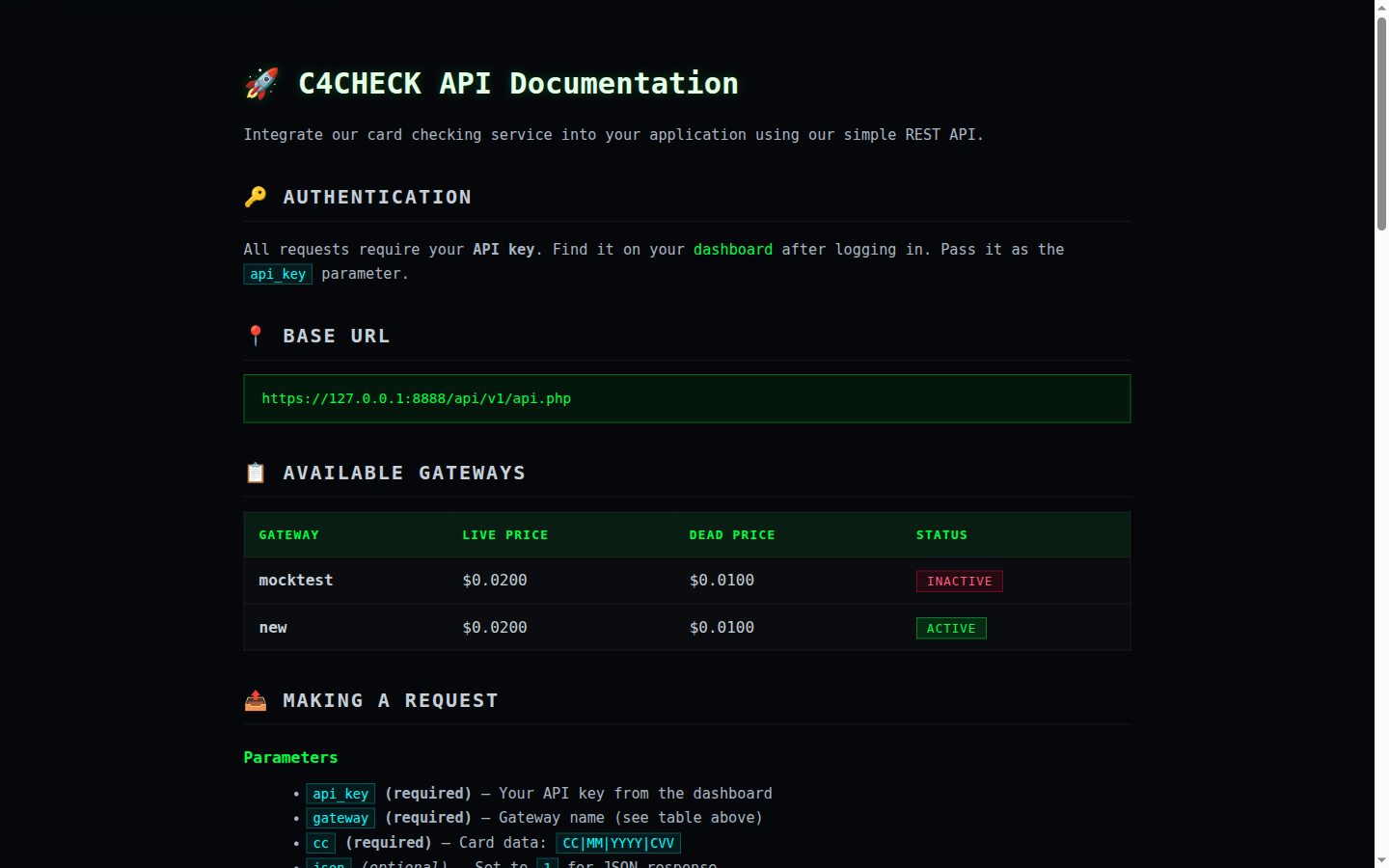
The card checker API exposes the same engine as the web checker: one endpoint, API-key authentication, and a structured result per card.
Quick start
GET /api/v1/api.php?gateway=new&cc=4307410677293014|01|2030|651&json=1\nHeaders: X-API-Key: your_keyResponse:
{"status": true, "result": "Live", "balance": "49.95", "charge": "0.0500"}Key features
- Per-result billing — only classified results cost balance; errors are free.
- Idempotent — request IDs prevent double charges on retries.
- Gateway selection — pick the gateway that fits your workload.
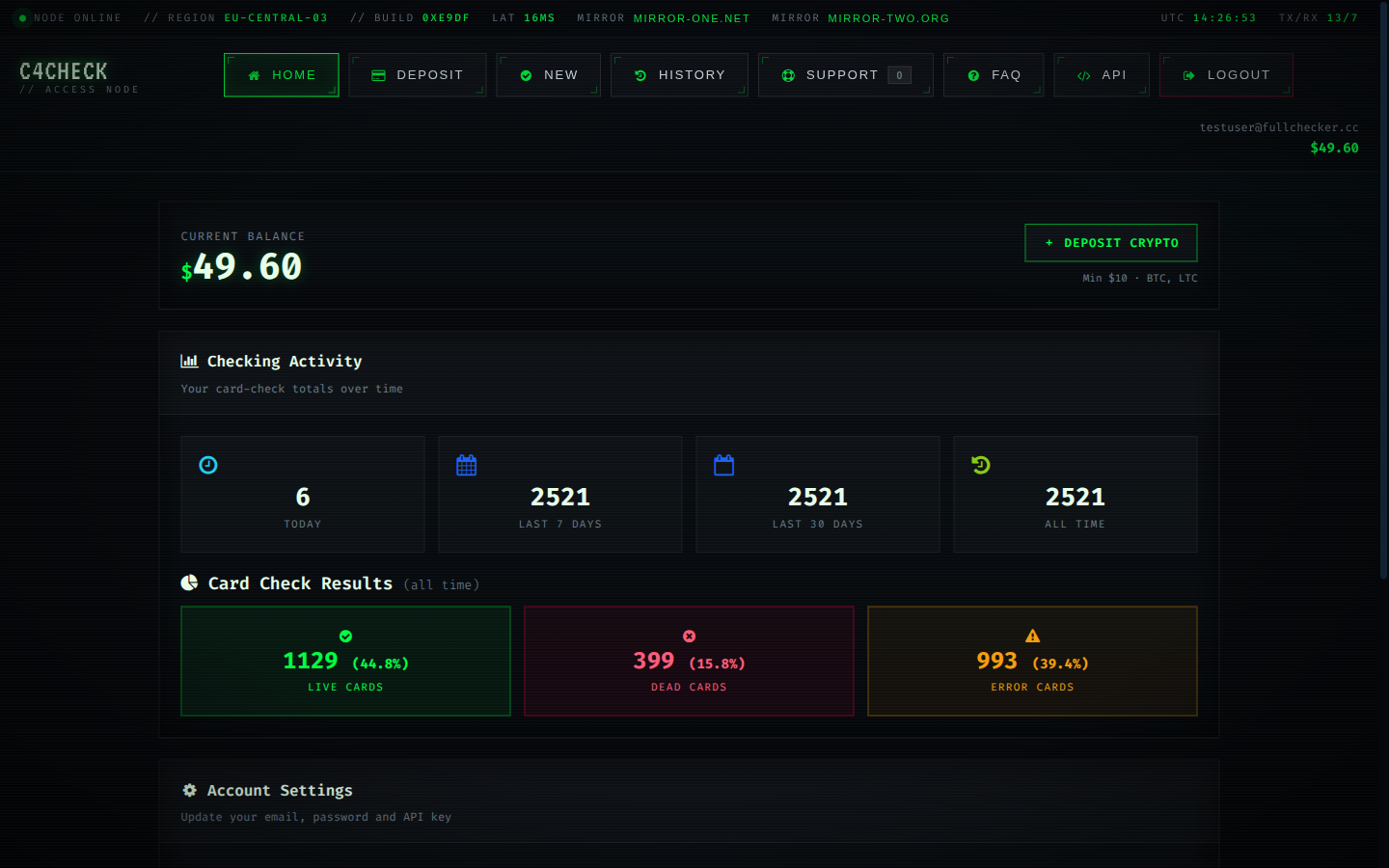
- Balance in every response — automate top-up alerts.
Integration guides
- Python · Node.js · PHP · cURL · Postman
- Full integration guide and API reference.
API checks always bill normally; free-check promotions apply to the web checker only.
The CC checker API exposes the same verification engine as the web tool through one REST endpoint: send the gateway and card in the route's format, receive the classification plus balance and charge. Authentication is a header key, responses are JSON, and the OpenAPI description is available for tooling.
For integration planning, the properties that matter are the ones you do not have to build: errors are never billed, every response meters the balance, and history stores the audit trail. That leaves retry logic and key hygiene as the main concerns on your side.
Key points about the CC checker API
- One endpoint, JSON responses, header authentication
- Result field drives routing: live/dead/unknown/error
- Errors free; every response carries the balance
- OpenAPI spec available for client generation
The CC checker API via the REST API
A machine-readable OpenAPI description is available for Postman, Insomnia and client generation. Branch on the result field rather than the HTTP status alone: a successful response can still carry an error outcome. Reconcile timeout outcomes before assuming failure — the answer may exist even when the response did not arrive. Keep the integration boring: one endpoint, one key, explicit handling for the four result classes. It is a small rule that changes how the CC checker API behaves at scale.
Security hygiene around the CC checker API
Regenerate the key the moment compromise is suspected; every check remains attributed in history, so the audit trail survives. Check inputs are account-scoped and retained under the platform retention window, then purged by the scheduled cleanup. Aggregate statistics are computed without exposing individual records, which is why published numbers can be useful without being risky. Verification data is operational data — treat it with the same care as any other sensitive business record. Write it down; the CC checker API workflows live and die on small consistencies.
Interpreting outcomes in the CC checker API
- Errors in the CC checker API return to the queue after the cause is fixed, because they produced no answer at all.
- Dead results in the CC checker API route to recovery: dunning, an update-payment prompt or list cleanup.
- In the CC checker API, live results route forward: billing, approval or completion, depending on the workflow.
- Unknown results in the CC checker API get one fallback pass on a second route, then a defined resting state.
Classified rate is the share of cards that produce a definitive answer; it is the first number to compare when switching gateways. Dead results are conclusive for the moment and should never be re-checked in the same run; retries on dead cards spend balance for identical answers. When a result contradicts other evidence, re-check once after a reasonable interval rather than assuming the checker is wrong. The habit costs nothing and removes a recurring class of mistakes.
Running the CC checker API well: the operating steps
Validate checksums and expiry dates before any paid request; the free browser tools exist precisely so malformed rows never reach a provider. Size batches to the provider ceiling. Past that line, extra concurrency converts into timeouts rather than throughput. Watch two numbers over time: the classified rate and the error rate. Together they explain almost every surprise in monthly spend. Start with a pilot of fifty cards. It surfaces format mismatches and routing surprises while the cost of being wrong is still measured in cents. The habit costs nothing and removes a recurring class of mistakes.
Boundaries of the CC checker API
Results describe the account, never the person; they should inform routing and risk decisions, not identity decisions. Check only cards you own or are authorised to process; verification is not a shortcut around cardholder authorization. Verification is at its best when it is boring: a routine status step inside an existing, authorised process. Remember it the next time the CC checker API produces an ambiguous answer.
Running the CC checker API as a process
Alert on classified-rate drops, not just on errors; silent degradation is the expensive kind. Budget verification against the cost of failure, not against zero; the comparison is what makes spend defensible. Keep the API key server-side and regenerable; a leaked key is a billing incident as much as a security one. Reconcile spend monthly against classified results; the difference between the two numbers is where retries hide. That distinction is what keeps the CC checker API decisions clean.
Reading the CC checker API results honestly
A result is only as fresh as its timestamp. High-value decisions should use checks that ran close to the moment of the decision. Dead results are conclusive for the moment and should never be re-checked in the same run; retries on dead cards spend balance for identical answers. Classified rate is the share of cards that produce a definitive answer; it is the first number to compare when switching gateways. A live answer is evidence about the account, not a guarantee about a specific future transaction; issuer rules can change between the check and the charge. Holding that line is what makes the CC checker API reliable over time.
The CC checker API in numbers
Sample sizes matter. Small windows produce noisy percentages, which is why published aggregates carry minimum thresholds. The platform publishes outcome distributions and latency percentiles from real traffic, refreshed monthly, precisely so expectations can be calibrated against reality. Cost per classified card is the honest metric. A cheap-per-request route with a high failure rate is the most expensive option in practice. Trends beat snapshots: a classified rate that drifts over weeks says more than any single run's result. That single habit separates routine the CC checker API from expensive the CC checker API.
Pitfalls that cost money in the CC checker API
Skipping format validation before the CC checker API turns simple input mistakes into provider rejects that look like card problems. Using BIN reference data as account status in the CC checker API confuses two different questions and produces confident, wrong decisions. Treating an error as a dead card in the CC checker API throws away cards that were never classified, and errors are the cheapest outcomes to recover.
- Using BIN reference data as account status in the CC checker API confuses two different questions and produces confident, wrong decisions.
- Ignoring the p90 latency of the CC checker API leads to timeouts that look like provider faults.
- Increasing parallelism past the provider ceiling in the CC checker API converts capacity into timeouts.
- Ignoring cost per classified card hides the real price of a cheap the CC checker API route with a high failure rate.
Limits and responsible use of the CC checker API
Results describe the account, never the person; they should inform routing and risk decisions, not identity decisions. Operators remain responsible for the legal basis on which they hold and process card data. Where a check is used inside a payment flow, it complements authorization rather than replacing it. That distinction is what keeps the CC checker API decisions clean.
Scaling the CC checker API without surprises
Track cost per classified card rather than cost per request; it is the only metric that reflects retries and unknown rates. Keep one primary gateway and one fallback, and switch on evidence — error spikes and classified-rate drops — rather than on price alone. Budget verification against the cost of failure, not against zero; the comparison is what makes spend defensible. Treat provider outages as routing problems: switch routes, recover the unclassified remainder, keep the answers you already paid for. The habit costs nothing and removes a recurring class of mistakes.