KEY TAKEAWAYS
- cURL with --data-urlencode safely handles card separators.
- jq turns responses into readable one-liners.
- Batch loops should pace requests to the gateway limit.
- Keep keys in environment variables, not scripts.
- Failed the cURL integration checks say nothing about the card — fix the cause and retry.
- Treat the cURL integration results as routing signals, not proof of future behavior.
The API answers GET with query parameters, which makes cURL ideal for one-off checks, cron jobs and shell scripts.
Single card
curl -s \
  -H "X-API-Key: $CARD_CHECKER_API_KEY" \
  "https://c4check.com/api/v1/api.php?gateway=new&cc=4307410677293014|01|2030|651&json=1" \
  | jq .
Expected output shape:
{ "status": true, "result": "Live", "balance": "49.95", "charge": "0.0500" }URL-encoding matters
The | separators in the card string must survive shell and URL parsing. Either use --data-urlencode with --get, or quote carefully:
curl -s -G \
  -H "X-API-Key: $CARD_CHECKER_API_KEY" \
  --data-urlencode "gateway=new" \
  --data-urlencode "cc=4307410677293014|01|2030|651" \
  --data-urlencode "json=1" \
  "https://c4check.com/api/v1/api.php"
Batch loop
while IFS= read -r card; do
  [ -z "$card" ] && continue
  result=$(curl -s -G -H "X-API-Key: $CARD_CHECKER_API_KEY" \
    --data-urlencode "gateway=new" \
    --data-urlencode "cc=$card" \
    --data-urlencode "json=1" \
    "https://c4check.com/api/v1/api.php")
  echo "$result" | jq -r --arg c "$card" '[$c, .result, .balance] | @tsv'
  sleep 0.2
done < cards.txt
The small sleep respects provider limits; remove it only when you know the gateway's ceiling. For larger jobs use the bulk verification script or the web checker with streaming results.
Security
Export the key in your shell or secret manager; never bake it into scripts or shell history on shared machines. Use history -d or a leading space to keep it out of history.
cURL is the fastest way to confirm the API behaves as documented before writing any integration code. One request with the key in a header, a gateway parameter and a card in that gateway's format returns a JSON body with the classification, balance and charge — everything needed to validate connectivity, billing and the result shape.
The examples below cover a single check and the error path. Keep the key in a shell variable or secret store rather than in history, and treat any 401 as a configuration problem, not a card problem.
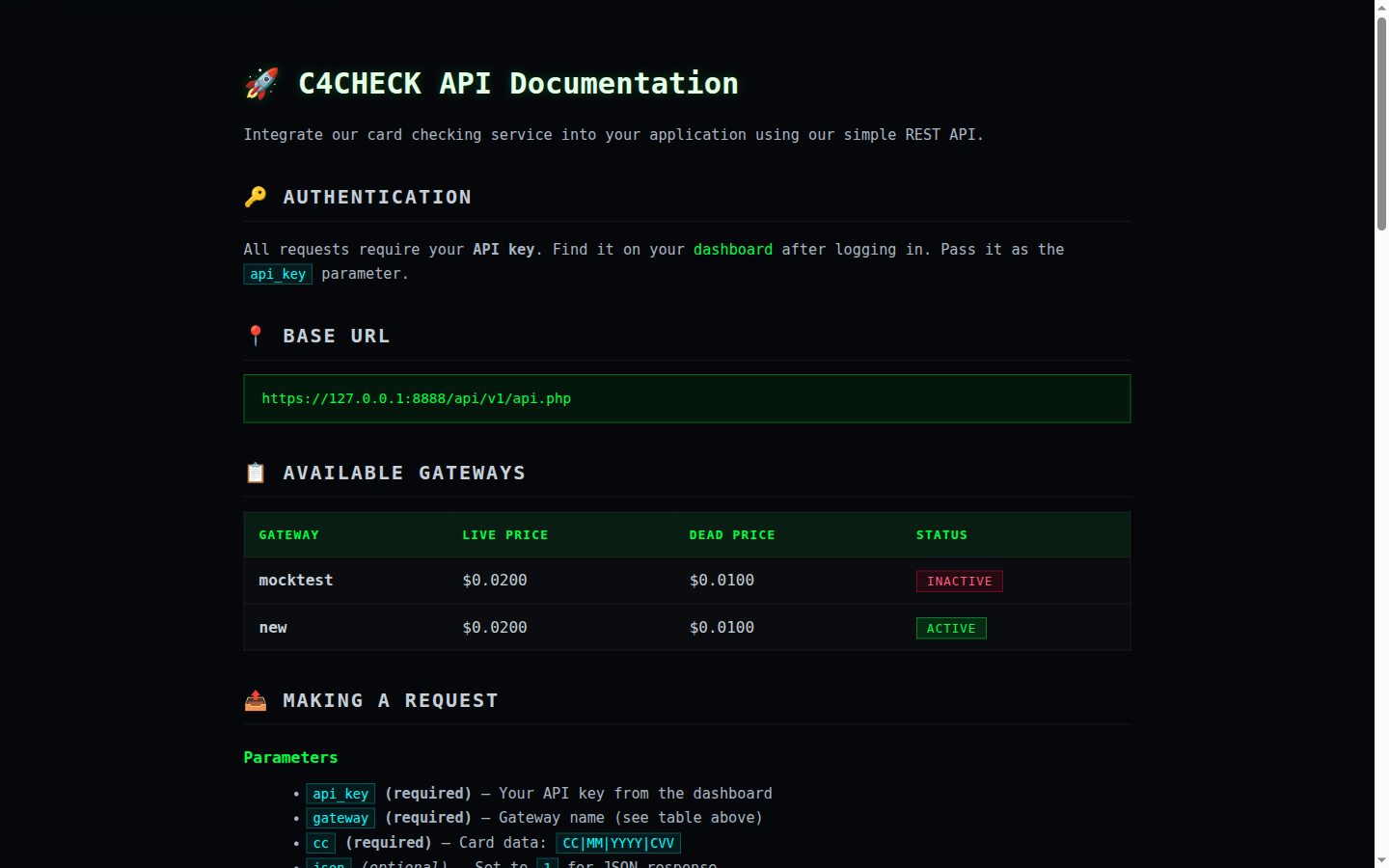
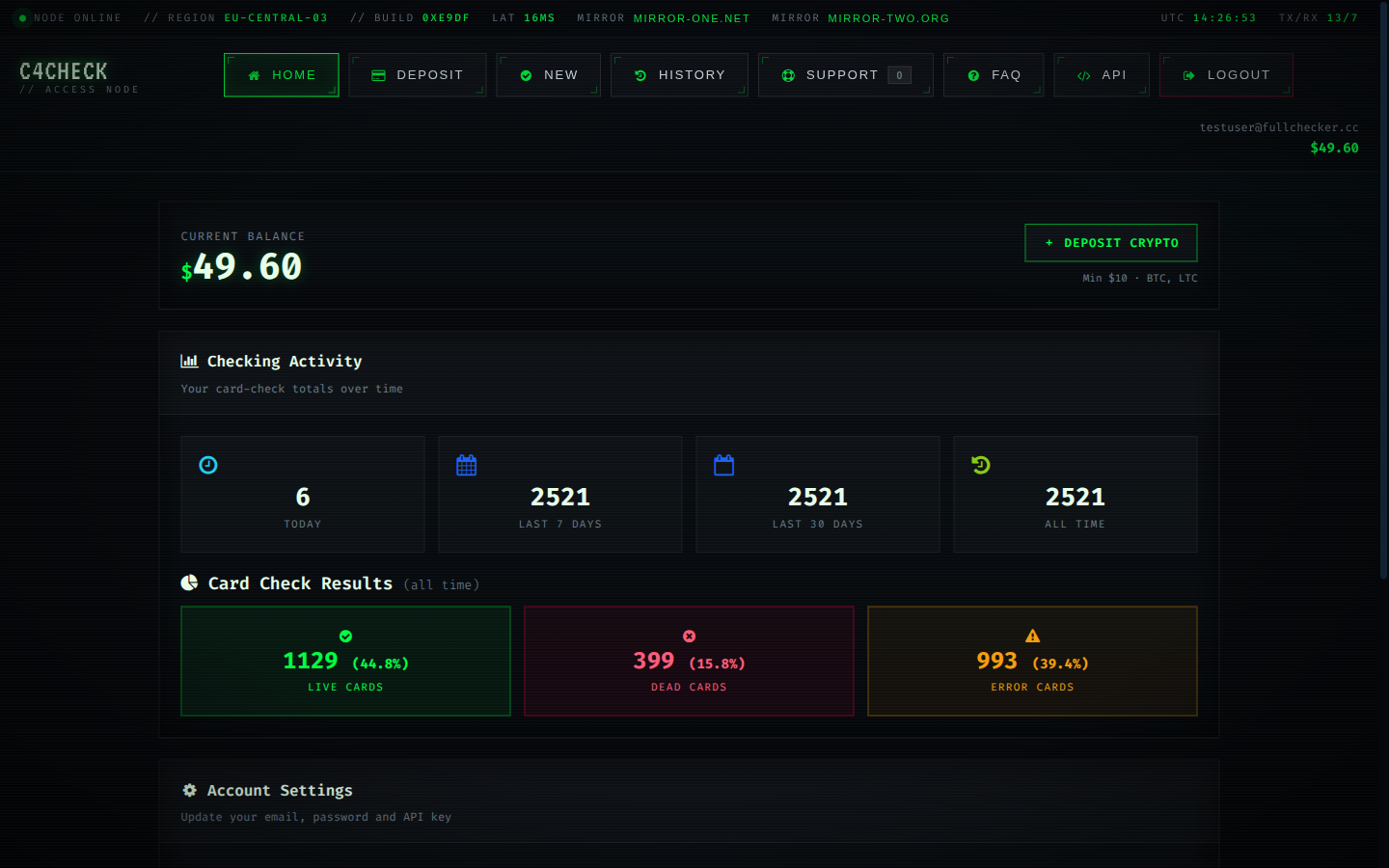
A concrete the cURL integration example
curl -s -H "X-API-Key: $C4CHECK_KEY" \
  "https://c4check.com/api/v1/api.php?gateway=GATEWAY&cc=4307410677293014|01|2030|651&json=1"
Automation pays off on scheduled workloads: card-on-file audits and route health checks are the classic candidates. Regenerating the key takes one click on the dashboard and invalidates the old one immediately. Add a circuit breaker: when the error rate crosses a threshold, pause the run and move the remainder to the fallback route. Holding that line is what makes the cURL integration reliable over time.
The cURL integration via the REST API
A machine-readable OpenAPI description is available for Postman, Insomnia and client generation. Automation pays off on scheduled workloads: card-on-file audits and route health checks are the classic candidates. Idempotency is your responsibility on the calling side; networks retry, and a retry without protection can duplicate work. Reconcile timeout outcomes before assuming failure — the answer may exist even when the response did not arrive. Keep it in mind whenever the cURL integration results are reviewed.
Handling keys and data in the cURL integration
Check inputs are account-scoped and retained under the platform retention window, then purged by the scheduled cleanup. Aggregate statistics are computed without exposing individual records, which is why published numbers can be useful without being risky. Verification data is operational data — treat it with the same care as any other sensitive business record. Regenerate the key the moment compromise is suspected; every check remains attributed in history, so the audit trail survives. Holding that line is what makes the cURL integration reliable over time.
From the cURL integration result to decision
- Errors in the cURL integration return to the queue after the cause is fixed, because they produced no answer at all.
- Dead results in the cURL integration route to recovery: dunning, an update-payment prompt or list cleanup.
- In the cURL integration, live results route forward: billing, approval or completion, depending on the workflow.
- Unknown results in the cURL integration get one fallback pass on a second route, then a defined resting state.
The honest reading of unknown is "no answer yet". The card is neither good nor bad, and the remedy is a different route, not a repeat of the same one. Two metrics describe any run: how many cards classify, and how long the pass takes. Everything else is commentary. Errors are free by design: no classification means no charge, so retrying after fixing the cause costs nothing but effort. In the cURL integration work, that is the difference between a signal and a guess.
The cURL integration in practice: a repeatable path
Watch two numbers over time: the classified rate and the error rate. Together they explain almost every surprise in monthly spend. For recurring workloads, schedule the run before the moment the answer is needed — ahead of a billing cycle, a payout batch or an onboarding window. Keep a small balance buffer so an interrupted run never leaves a half-classified list and the temptation to re-check everything. Run one primary gateway with a fallback route. When the primary degrades, re-run only the unclassified remainder on the fallback. In the cURL integration work, that is the difference between a signal and a guess.
Using the cURL integration on the right side of the line
The platform does not trade card data, and nothing in the system is designed to bypass a cardholder's consent. Operators remain responsible for the legal basis on which they hold and process card data. Where a check is used inside a payment flow, it complements authorization rather than replacing it. It sounds obvious until a real run tests it.
Keeping the cURL integration predictable
Alert on classified-rate drops, not just on errors; silent degradation is the expensive kind. Schedule recurring checks ahead of the decisions they inform, not after them. Keep one primary gateway and one fallback, and switch on evidence — error spikes and classified-rate drops — rather than on price alone. Keep the API key server-side and regenerable; a leaked key is a billing incident as much as a security one. Remember it the next time the cURL integration produces an ambiguous answer.
What each the cURL integration outcome commits you to
Errors are free by design: no classification means no charge, so retrying after fixing the cause costs nothing but effort. Classified rate is the share of cards that produce a definitive answer; it is the first number to compare when switching gateways. Dead results are conclusive for the moment and should never be re-checked in the same run; retries on dead cards spend balance for identical answers. The honest reading of unknown is "no answer yet". The card is neither good nor bad, and the remedy is a different route, not a repeat of the same one. That single habit separates routine the cURL integration from expensive the cURL integration.