KEY TAKEAWAYS
- Authenticate with a header key and call one endpoint per card.
- Branch on status, then on result: live/dead/charge/error.
- Retry only transient failures, with backoff.
- Track the returned balance to avoid mid-run exhaustion.
- Watch classified rate and latency trends, not just the balance.
- One primary gateway plus one fallback keeps the Python integration resilient.
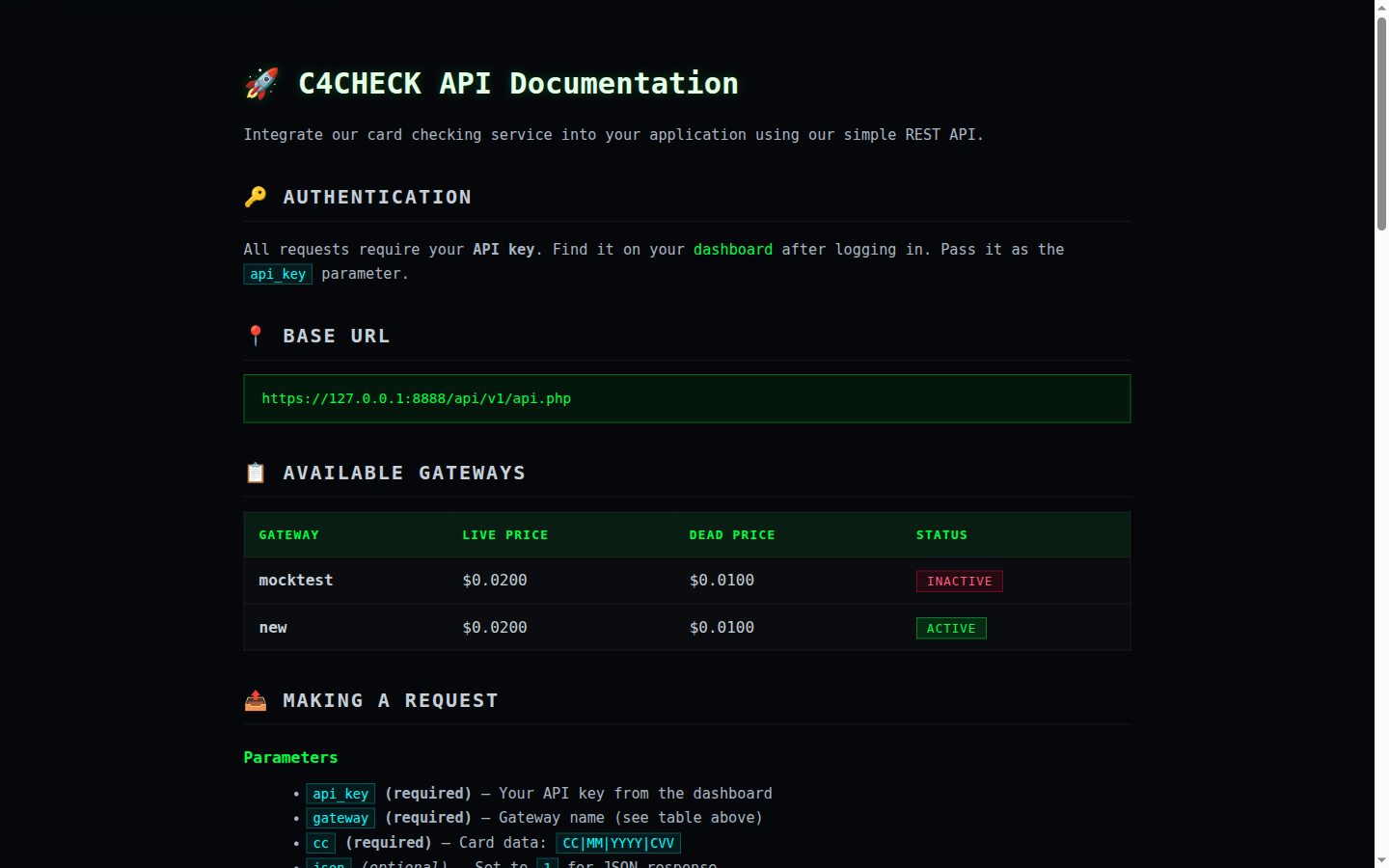
The card checker API is a small REST surface: authenticate with a key header, submit one card, receive a classification and your balance. Here is a complete Python client with correct error handling.
Minimal request
import requests

API_URL = "https://c4check.com/api/v1/api.php"
API_KEY = "your_api_key"  # keep in an env var, never in code

def check_card(card: str, gateway: str, timeout: int = 60) -> dict:
    r = requests.get(
        API_URL,
        params={"gateway": gateway, "cc": card, "json": "1"},
        headers={"X-API-Key": API_KEY},
        timeout=timeout,
    )
    r.raise_for_status()
    return r.json()

result = check_card("4307410677293014|01|2030|651", "new")
print(result["result"], result["balance"])
Handling results
def classify(resp: dict) -> str:
    if not resp.get("status"):
        return "retry"  # auth/billing/transient error
    result = (resp.get("result") or "").lower()
    if result == "live":
        return "proceed"
    if result == "dead":
        return "discard"
return "review" # charge/unknown- live → usable; proceed with your normal risk checks.
- dead → retire the card; never retry.
- charge/unknown → retry on a fallback gateway or park.
- status: false → read the error (auth, balance, rate limit); not billed.
Retries that do not double-charge
Only retry transport errors and 5xx/429 responses, with exponential backoff and a small retry budget. Requests that fail before producing a result are not billed, and the platform's idempotency ensures one request ID is processed once. Background: error handling guide.
Balance tracking
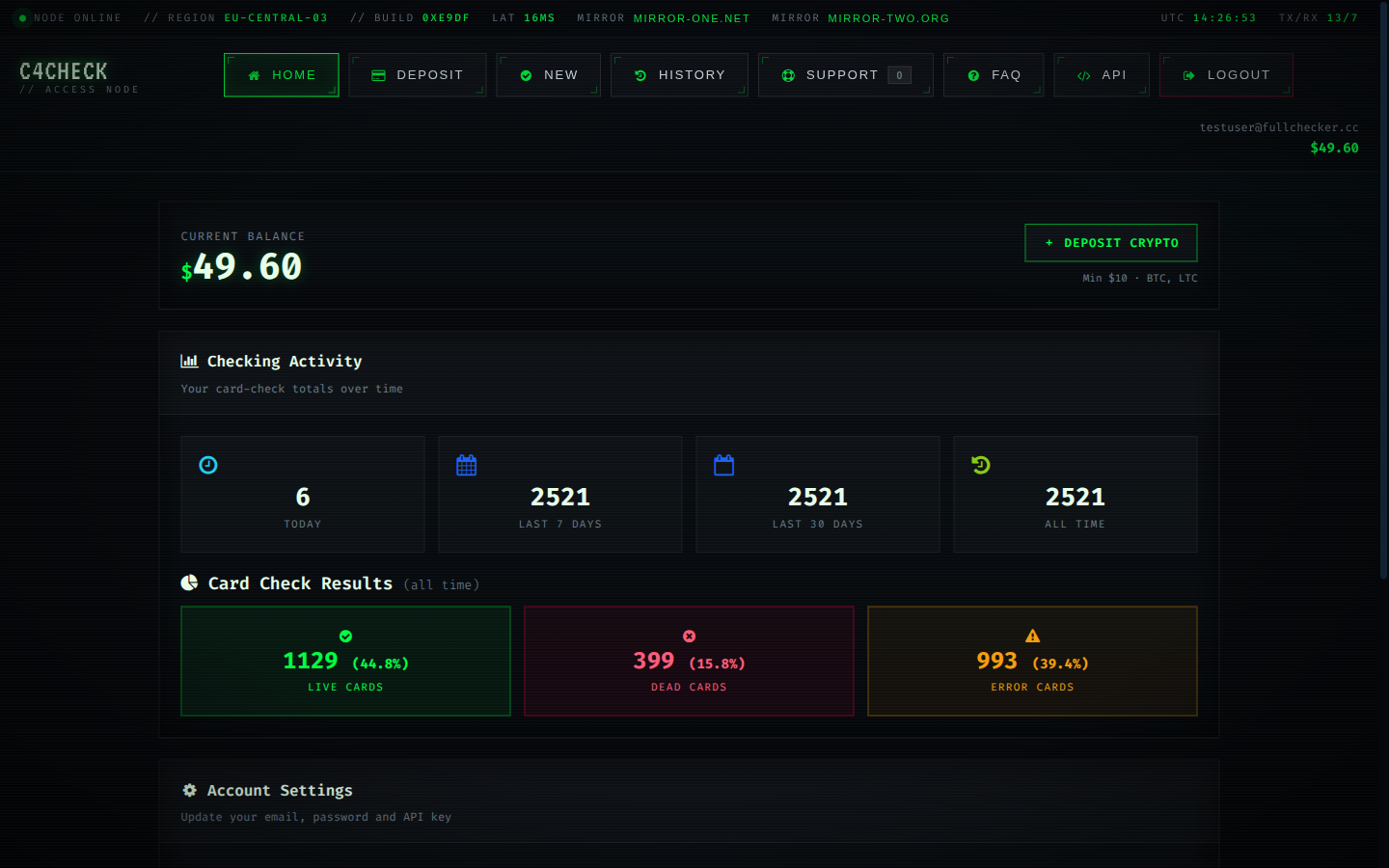
Every response includes the current balance; alert when it drops below the cost of a run. For batch processing, see the bulk verification script.
Python integrations benefit from treating the four result classes as first-class branches: a dictionary of handlers keyed by result keeps live, dead, unknown and error paths explicit instead of buried in conditionals. Requests with a short timeout and a bounded retry loop cover the transient failures the API already documents as free.
The sample below uses only the standard library plus requests, reads the key from the environment, and returns structured outcomes — the shape most billing and risk pipelines want.
A concrete the Python integration example
import os, requests

KEY = os.environ["C4CHECK_KEY"]

def check(gateway, card):
    r = requests.get(
        "https://c4check.com/api/v1/api.php",
        params={"gateway": gateway, "cc": card, "json": 1},
        headers={"X-API-Key": KEY}, timeout=30)
    r.raise_for_status()
    return r.json()  # result, balance, charge
A machine-readable OpenAPI description is available for Postman, Insomnia and client generation. Reconcile timeout outcomes before assuming failure — the answer may exist even when the response did not arrive. Idempotency is your responsibility on the calling side; networks retry, and a retry without protection can duplicate work. In the Python integration work, that is the difference between a signal and a guess.
Automating the Python integration through the API
Automation pays off on scheduled workloads: card-on-file audits and route health checks are the classic candidates. Regenerating the key takes one click on the dashboard and invalidates the old one immediately. Branch on the result field rather than the HTTP status alone: a successful response can still carry an error outcome. Authenticate with the API key in a request header; a key in a URL or in client-side code is a leak waiting to happen. The habit costs nothing and removes a recurring class of mistakes.
Keeping the Python integration secure
Encrypted transport and account-scoped access are defaults; nothing about the integration requires changing them. API keys are server-side secrets: they belong in environment configuration, never in URLs, logs or client bundles. Log identifiers and outcomes, not card numbers. Debugging almost never requires a PAN. The dashboard shows the key once and lets you rotate it at will; rotation is cheap, leaks are not. Remember it the next time the Python integration produces an ambiguous answer.
Interpreting outcomes in the Python integration
- Unknown results in the Python integration get one fallback pass on a second route, then a defined resting state.
- In the Python integration, live results route forward: billing, approval or completion, depending on the workflow.
- Errors in the Python integration return to the queue after the cause is fixed, because they produced no answer at all.
- Dead results in the Python integration route to recovery: dunning, an update-payment prompt or list cleanup.
Classified rate is the share of cards that produce a definitive answer; it is the first number to compare when switching gateways. Conflating outcomes is the most expensive habit in this area — an error treated as a dead card discards real inventory, and an unknown treated as live inflates confidence. Errors are free by design: no classification means no charge, so retrying after fixing the cause costs nothing but effort. Keep it in mind whenever the Python integration results are reviewed.
A working routine for the Python integration
Keep a small balance buffer so an interrupted run never leaves a half-classified list and the temptation to re-check everything. Decide how each outcome is handled before the run starts; a triage plan written after the results arrive is usually just a spreadsheet. For recurring workloads, schedule the run before the moment the answer is needed — ahead of a billing cycle, a payout batch or an onboarding window. Size batches to the provider ceiling. Past that line, extra concurrency converts into timeouts rather than throughput. Keep it in mind whenever the Python integration results are reviewed.
What the Python integration cannot promise
A check does not move money, does not create a charge and does not touch the cardholder's credit file. The platform does not trade card data, and nothing in the system is designed to bypass a cardholder's consent. Results describe the account, never the person; they should inform routing and risk decisions, not identity decisions. That single habit separates routine the Python integration from expensive the Python integration.
Keeping the Python integration predictable
Alert on classified-rate drops, not just on errors; silent degradation is the expensive kind. Reconcile spend monthly against classified results; the difference between the two numbers is where retries hide. Keep the API key server-side and regenerable; a leaked key is a billing incident as much as a security one. Keep one primary gateway and one fallback, and switch on evidence — error spikes and classified-rate drops — rather than on price alone. Holding that line is what makes the Python integration reliable over time.
Reading the Python integration results honestly
The honest reading of unknown is "no answer yet". The card is neither good nor bad, and the remedy is a different route, not a repeat of the same one. The four result classes are a decision matrix, not a score: live proceeds, dead recovers, unknown gets one careful retry, error returns to the queue. A live answer is evidence about the account, not a guarantee about a specific future transaction; issuer rules can change between the check and the charge. A result is only as fresh as its timestamp. High-value decisions should use checks that ran close to the moment of the decision. Remember it the next time the Python integration produces an ambiguous answer.