KEY TAKEAWAYS
- Diners Club uses 36, 38 or 300–305 with 14 digits (14–19 supported).
- Security code: 3 digits (back).
- Format checks are free; live status needs an issuer check.
- Validate locally first to avoid spending checks on bad rows.
- Every Diners Club card checking result class should map to a defined workflow action.
- Unknown deserves one fallback pass, not infinite retries.
Every network has its own number format — Diners Club included. This page covers the format facts you need for correct validation, and how to verify live status beyond the format.
Diners Club format at a glance
| Property | Value |
|---|---|
| Prefix / IIN ranges | 36, 38 or 300–305 |
| Number length | 14 digits (14–19 supported) |
| Security code | 3 digits (back) |
| Checksum | Luhn (mod 10) |
What is specific about Diners Club
- Diners Club is the original charge card network and commonly uses 14-digit numbers — a classic tripwire for validators that assume 16.
- The network operates through Discover in several regions; issuer responses still classify normally.
- Charge-card behaviour means authorisation limits differ from revolving credit, but verification reports account status independently.
Validating and verifying
Bulk Diners Club lists
Diners Club is the brand where length validation earns its keep: numbers run 14 to 16 digits across prefixes 300–305, 3095, 36 and 38–39. A length assumption borrowed from Visa or Mastercard will reject valid Diners numbers before any check runs.
Provider coverage is narrower than the big networks, so confirm gateway support and expect more unknowns on cross-border traffic. Reference data resolves the issuer cleanly; the live answer resolves the account.
What is different about Diners Club
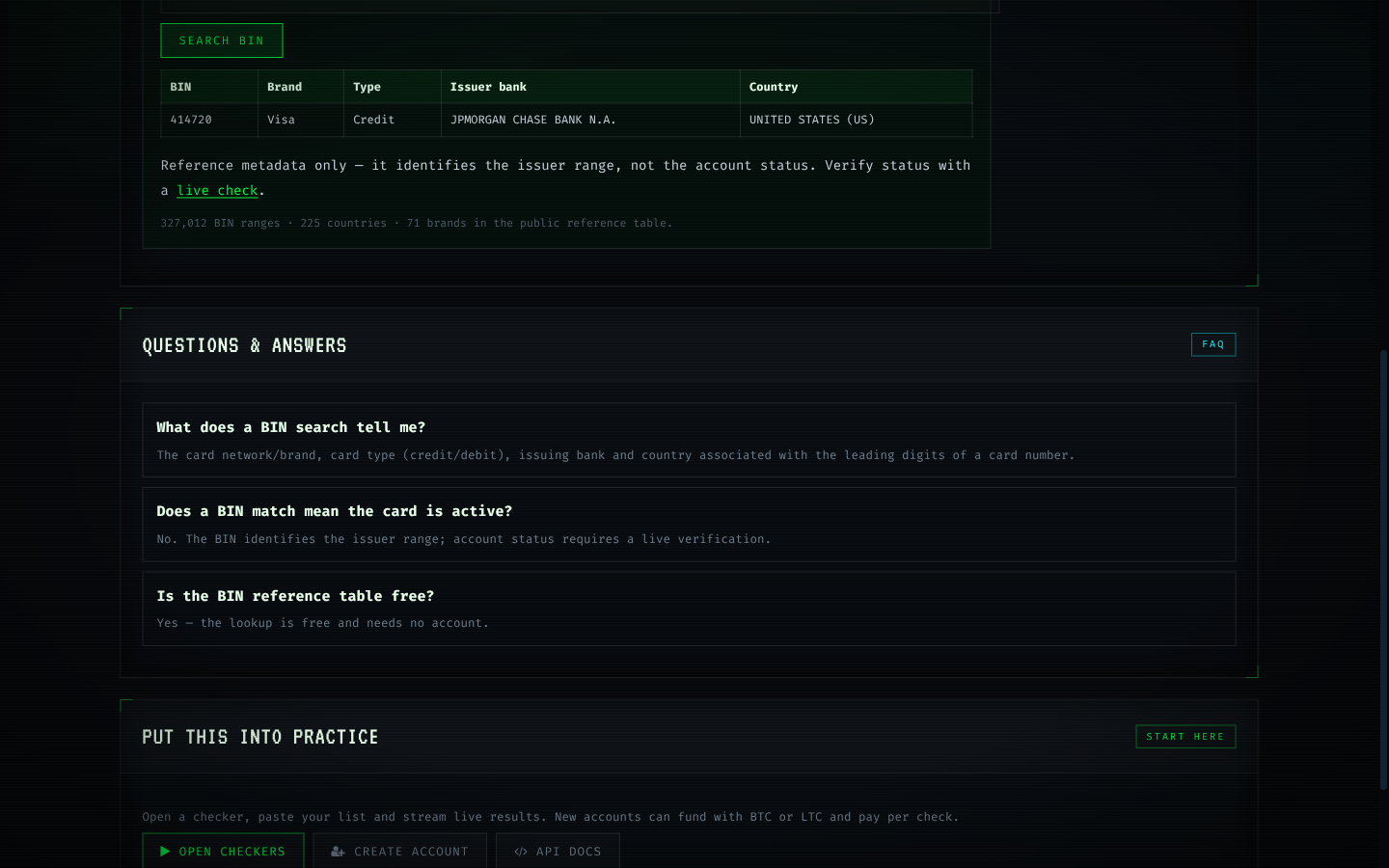
The reference data holds Diners Club ranges across many issuing banks, and the BIN tools expose them directly. Reference metadata for Diners Club tells you the issuer and type; only a live check reveals whether the account is active. Diners Club behaviour is shaped by both the network and the issuing bank, which is why two cards with the same brand can resolve differently. When a Diners Club check returns error, suspect the format or the route first — the card is still unclassified. Write it down; Diners Club card checking workflows live and die on small consistencies.
The BIN layer behind Diners Club card checking
Issuers move portfolios between banks and reissue ranges, so BIN data ages and should be refreshed from maintained sources. Because BIN data is public reference material, it is safe to cache, but it should be re-validated periodically. Six digits usually identify the institution; eight add the program or product level on many ranges. A BIN identifies the issuing institution and network; it says nothing about whether an account is open. That single habit separates routine Diners Club card checking from expensive Diners Club card checking.
Diners Club card checking in practice: a repeatable path
Treat every large list as two lists: the part that classifies on the first pass, and the remainder that needs a decision about how hard to chase. When results look wrong, diagnose in order: input format, route, provider health, and only then the cards themselves. Decide how each outcome is handled before the run starts; a triage plan written after the results arrive is usually just a spreadsheet. Start with a pilot of fifty cards. It surfaces format mismatches and routing surprises while the cost of being wrong is still measured in cents. Keep it in mind whenever Diners Club card checking results are reviewed.
What each Diners Club card checking outcome commits you to
A result is only as fresh as its timestamp. High-value decisions should use checks that ran close to the moment of the decision. Two metrics describe any run: how many cards classify, and how long the pass takes. Everything else is commentary. When a result contradicts other evidence, re-check once after a reasonable interval rather than assuming the checker is wrong. Classified rate is the share of cards that produce a definitive answer; it is the first number to compare when switching gateways. In Diners Club card checking work, that is the difference between a signal and a guess.
Boundaries of Diners Club card checking
A check does not move money, does not create a charge and does not touch the cardholder's credit file. When a proposed use cannot be explained to a compliance reviewer in one sentence, it is probably not a fit. Check only cards you own or are authorised to process; verification is not a shortcut around cardholder authorization. Remember it the next time Diners Club card checking produces an ambiguous answer.
Scaling Diners Club card checking without surprises
Alert on classified-rate drops, not just on errors; silent degradation is the expensive kind. Schedule recurring checks ahead of the decisions they inform, not after them. Reconcile spend monthly against classified results; the difference between the two numbers is where retries hide. Budget verification against the cost of failure, not against zero; the comparison is what makes spend defensible. The habit costs nothing and removes a recurring class of mistakes.
Pitfalls that cost money in Diners Club card checking
Mixing test numbers into production Diners Club card checking lists creates results that mean nothing. Running Diners Club card checking without a fallback means one degraded provider turns an entire batch into unknowns. Treating a Diners Club card checking snapshot as permanent truth overstates what verification can promise.
- Comparing Diners Club card checking routes on list price instead of classified rate hides the real economics.
- Ignoring cost per classified card hides the real price of a cheap Diners Club card checking route with a high failure rate.
- Treating a Diners Club card checking snapshot as permanent truth overstates what verification can promise.
- Storing card data beyond the needs of Diners Club card checking creates risk without adding value.
Using Diners Club card checking on the right side of the line
Verification is at its best when it is boring: a routine status step inside an existing, authorised process. Check only cards you own or are authorised to process; verification is not a shortcut around cardholder authorization. Verification is a signal, not a guarantee: a live result does not promise that a later charge will be approved. Holding that line is what makes Diners Club card checking reliable over time.
Measured behaviour of Diners Club card checking
The reference BIN table covers hundreds of thousands of issuer ranges, and it is deliberately separate from account-status data: one describes issuers, the other describes cards. When the classified rate moves, the cause is usually a route or provider change rather than the underlying cards. Aggregate numbers describe populations, not individual cards. Use them to size timeouts and retry budgets, never to judge one account. Latency percentiles matter more than averages: the p90 and p99 tell you what a slow run actually feels like. Keep it in mind whenever Diners Club card checking results are reviewed.