KEY TAKEAWAYS
- The Luhn algorithm validates the format of a card number, not its status.
- It catches single-digit typos and most neighbouring transpositions.
- Brand detection is based on the leading digits (IIN ranges).
- Run a live check to learn whether the account is active.
- A 50-card pilot removes most the Luhn validator surprises for cents.
- Generated test numbers are checksum-valid and never chargeable.
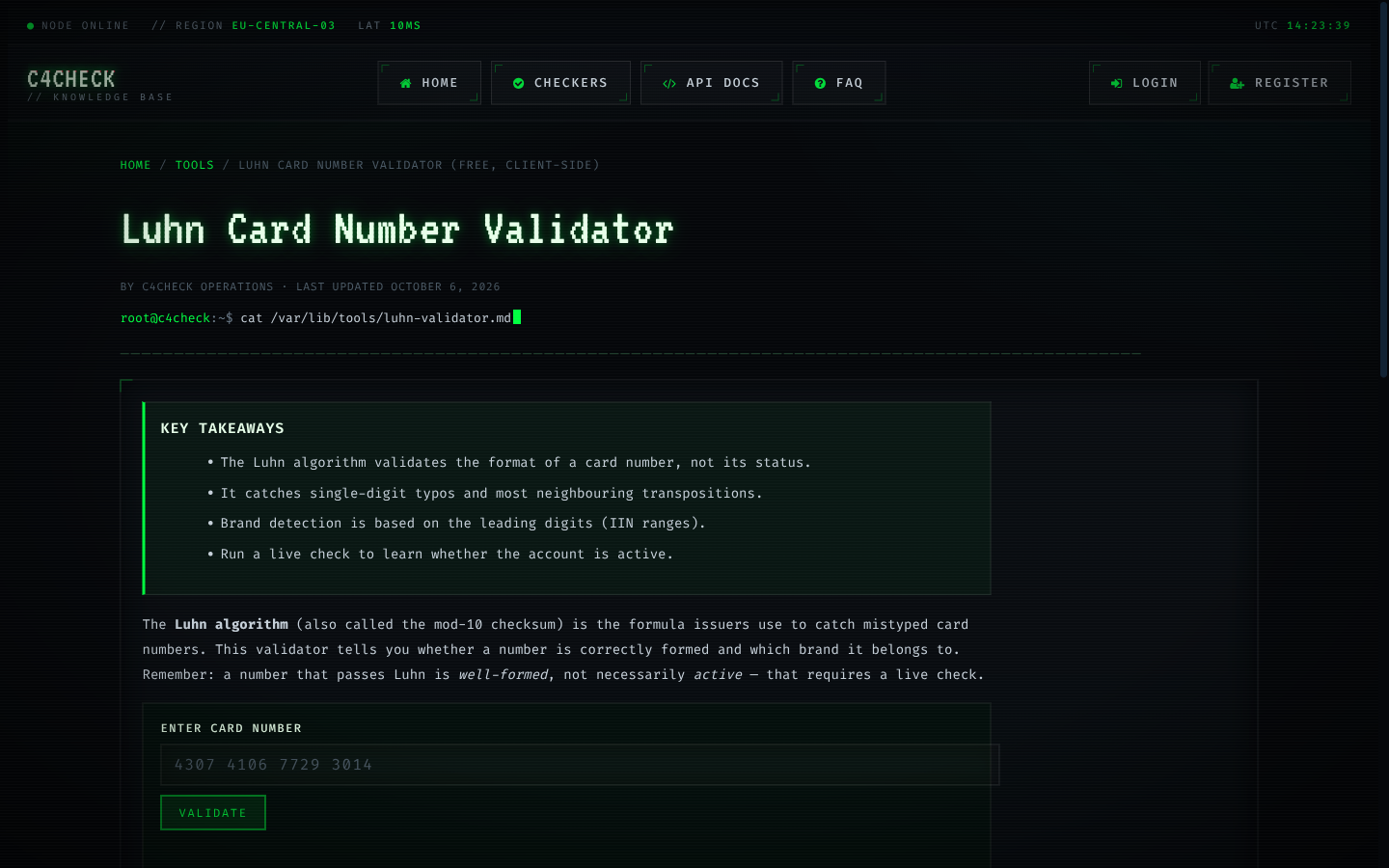
The Luhn algorithm (also called the mod-10 checksum) is the formula issuers use to catch mistyped card numbers. This validator tells you whether a number is correctly formed and which brand it belongs to. Remember: a number that passes Luhn is well-formed, not necessarily active — that requires a live check.
How it works
- Starting from the rightmost digit, double every second digit. If doubling exceeds 9, subtract 9.
- Sum all digits.
- If the total is divisible by 10, the number passes the checksum.
Luhn catches single-digit typos and most adjacent transpositions, but it cannot detect every error and says nothing about the account's status. For that, use a live checker or the API.
The Luhn validator applies the mod-10 checksum that every card number carries in its final digit. It catches the mistyped digit, the swapped pair, and the transposed block before any system treats the number as real work. It runs entirely in the browser, in milliseconds, on one number or a pasted list.
What it proves is narrow and useful: the number is structurally well-formed. What it cannot prove is that an account exists — for that, the number has to pass the paid gate and reach an issuer through a checker.
Key points about the Luhn validator
- One number or a full pasted list
- Per-row verdicts with the failing digit surfaced
- No network calls; nothing leaves the page
- The correct first gate before any paid check
Using the Luhn validator: step by step
- Paste numbers one per line (or a single number).
- Read the per-row result and fix flagged entries.
- Export or copy the clean list into your checker.
How the Luhn validator actually works
Nothing in the check moves money: the request asks a question, the issuer answers, and the platform records one of four outcomes against your account. Error means the check itself failed technically: a timeout, a provider fault or malformed input. No classification was produced, and no charge applies. A verification answer reflects the issuer's view at the moment of the request; nothing about it changes the card, the account or the cardholder. Dead means the account is closed, blocked or invalid. It is a final answer for the current state of the card and should never be retried blindly. It is a small rule that changes how the Luhn validator behaves at scale.
A check sends an authorization-shaped request through a provider to the issuer and classifies the reply into one of four states: live, dead, unknown or error. Unknown means no definitive answer was received — often an issuer challenge or soft decline — so the card remains unclassified and deserves at most one fallback pass. Live means the issuer answered and the account is active and chargeable at that moment; it is strong evidence, not a promise about a future charge. That distinction is what keeps the Luhn validator decisions clean.
A working routine for the Luhn validator
Validate checksums and expiry dates before any paid request; the free browser tools exist precisely so malformed rows never reach a provider. Log request identifiers and outcomes, never full card numbers. Debugging rarely needs a PAN, and storing one is a liability. Decide how each outcome is handled before the run starts; a triage plan written after the results arrive is usually just a spreadsheet. Run one primary gateway with a fallback route. When the primary degrades, re-run only the unclassified remainder on the fallback. Remember it the next time the Luhn validator produces an ambiguous answer.
The toolkit around the Luhn validator
The CSV cleaner normalises separators and removes duplicates, which is the cheapest way to protect a large run. Pair the generator with the Luhn validator when building test fixtures; checksum-valid numbers exercise real validation paths. IBAN validation follows country-specific rules and verifies the checksum, covering the payout side of card operations.
- expiry checker
- IIN lookup
- API integration guide
- Bin Lookup
- What Is A Card Checker
- Card Verification Glossary
What the Luhn validator cannot promise
Check only cards you own or are authorised to process; verification is not a shortcut around cardholder authorization. A check does not move money, does not create a charge and does not touch the cardholder's credit file. Verification is a signal, not a guarantee: a live result does not promise that a later charge will be approved. It sounds obvious until a real run tests it.
Benchmarks and distribution for the Luhn validator
Latency percentiles matter more than averages: the p90 and p99 tell you what a slow run actually feels like. Aggregate numbers describe populations, not individual cards. Use them to size timeouts and retry budgets, never to judge one account. When the classified rate moves, the cause is usually a route or provider change rather than the underlying cards. The reference BIN table covers hundreds of thousands of issuer ranges, and it is deliberately separate from account-status data: one describes issuers, the other describes cards. It sounds obvious until a real run tests it.
Running the Luhn validator as a process
Alert on classified-rate drops, not just on errors; silent degradation is the expensive kind. Schedule recurring checks ahead of the decisions they inform, not after them. Reconcile spend monthly against classified results; the difference between the two numbers is where retries hide. Keep the API key server-side and regenerable; a leaked key is a billing incident as much as a security one. Write it down; the Luhn validator workflows live and die on small consistencies.
Common mistakes around the Luhn validator
Chasing every unknown in the Luhn validator with unlimited retries costs more than classifying the rest of the list. Mixing test numbers into production the Luhn validator lists creates results that mean nothing. Letting duplicates through the input during the Luhn validator pays twice for the same answer.
- Skipping format validation before the Luhn validator turns simple input mistakes into provider rejects that look like card problems.
- Chasing every unknown in the Luhn validator with unlimited retries costs more than classifying the rest of the list.
- Assuming every the Luhn validator gateway covers every brand is the fastest way to a list full of errors.
- Treating an error as a dead card in the Luhn validator throws away cards that were never classified, and errors are the cheapest outcomes to recover.
Using the Luhn validator on the right side of the line
Verification is a signal, not a guarantee: a live result does not promise that a later charge will be approved. Results describe the account, never the person; they should inform routing and risk decisions, not identity decisions. Operators remain responsible for the legal basis on which they hold and process card data. That distinction is what keeps the Luhn validator decisions clean.
Interpreting outcomes in the Luhn validator
A result is only as fresh as its timestamp. High-value decisions should use checks that ran close to the moment of the decision. Two metrics describe any run: how many cards classify, and how long the pass takes. Everything else is commentary. The four result classes are a decision matrix, not a score: live proceeds, dead recovers, unknown gets one careful retry, error returns to the queue. When a result contradicts other evidence, re-check once after a reasonable interval rather than assuming the checker is wrong. Remember it the next time the Luhn validator produces an ambiguous answer.
Measured behaviour of the Luhn validator
The reference BIN table covers hundreds of thousands of issuer ranges, and it is deliberately separate from account-status data: one describes issuers, the other describes cards. Aggregate numbers describe populations, not individual cards. Use them to size timeouts and retry budgets, never to judge one account. When the classified rate moves, the cause is usually a route or provider change rather than the underlying cards. Latency percentiles matter more than averages: the p90 and p99 tell you what a slow run actually feels like. In the Luhn validator work, that is the difference between a signal and a guess.