KEY TAKEAWAYS
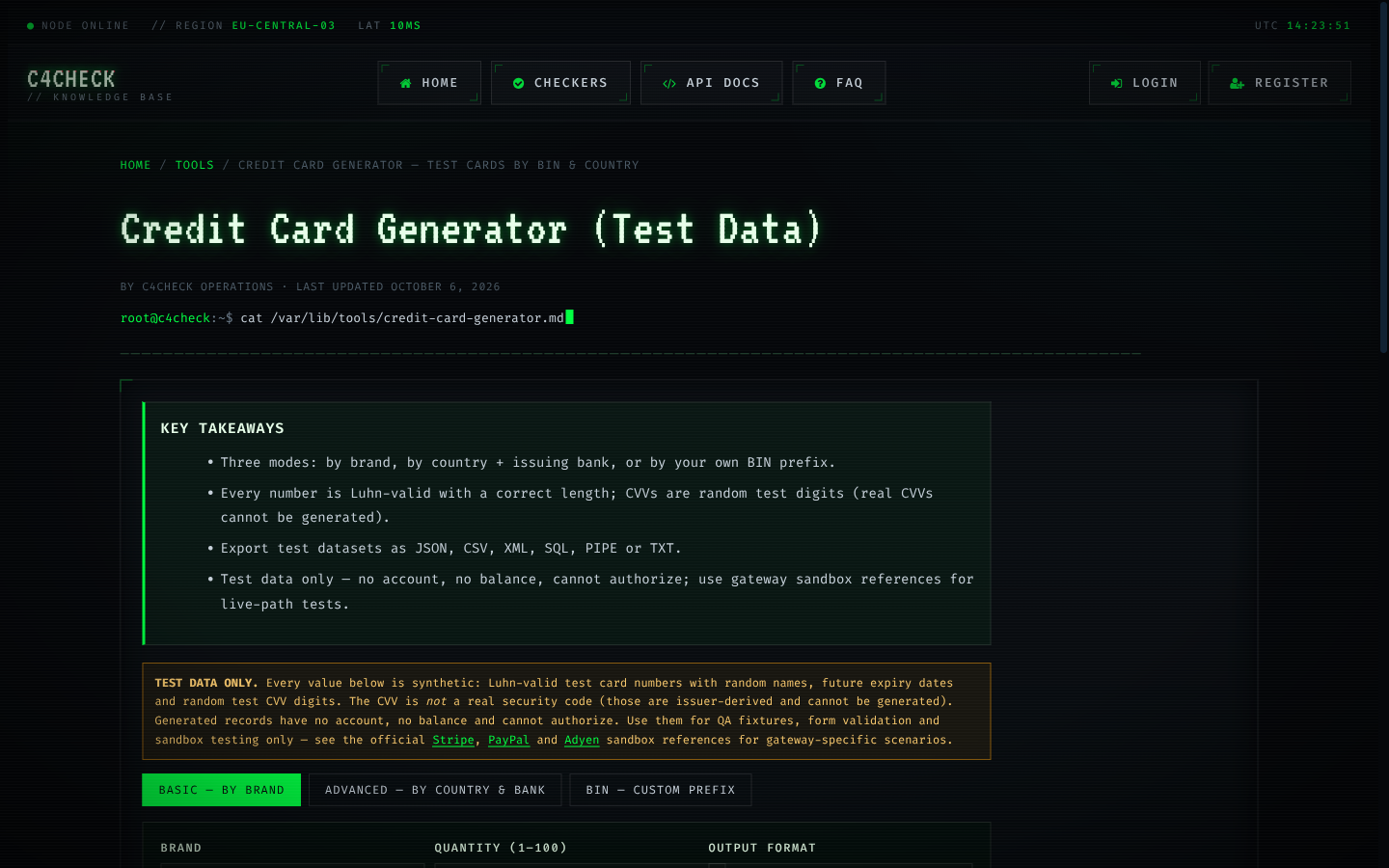
- Three modes: by brand, by country + issuing bank, or by your own BIN prefix.
- Every number is Luhn-valid with a correct length; CVVs are random test digits (real CVVs cannot be generated).
- Export test datasets as JSON, CSV, XML, SQL, PIPE or TXT.
- Test data only — no account, no balance, cannot authorize; use gateway sandbox references for live-path tests.
- A 50-card pilot removes most the test card generator surprises for cents.
- Deduplicate and validate before any paid the test card generator request.
The test card generator produces checksum-valid numbers in three modes: by brand, by country/brand/bank from the reference table, or from any BIN prefix. Every result is structurally correct for its brand — right prefix, right length, valid Luhn digit — and deliberately unchargeable, because a generated number belongs to no account.
That combination is exactly what development and QA need: numbers that exercise prefix detection, length rules, formatting and validation paths without touching real accounts or leaving the page.
Key points about the test card generator
- Basic, advanced (country/brand/bank) and BIN modes
- JSON, CSV, XML, SQL, PIPE and TXT export
- Checksum-valid by construction; never chargeable
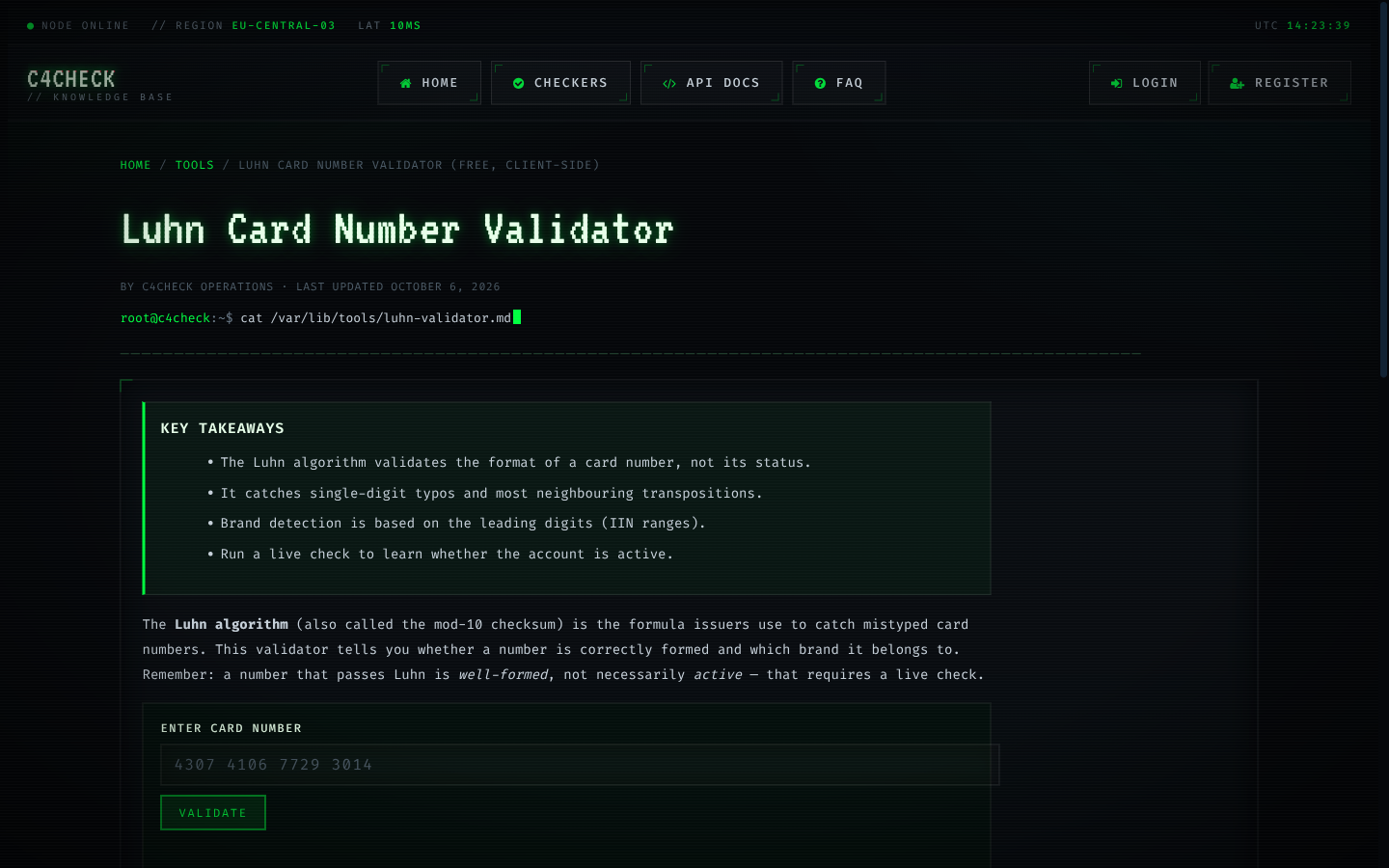
- Pair with the Luhn validator to double-check fixtures
A practical path through the test card generator
- Pick a mode and target brand or BIN.
- Set the count and generate.
- Export in the format your test suite consumes.
The mechanics behind the test card generator
The four outcomes are categorical rather than numeric because decisions are categorical too: proceed, recover, retry or log. Live means the issuer answered and the account is active and chargeable at that moment; it is strong evidence, not a promise about a future charge. Dead means the account is closed, blocked or invalid. It is a final answer for the current state of the card and should never be retried blindly. Nothing in the check moves money: the request asks a question, the issuer answers, and the platform records one of four outcomes against your account. It is a small rule that changes how the test card generator behaves at scale.
A verification answer reflects the issuer's view at the moment of the request; nothing about it changes the card, the account or the cardholder. A check sends an authorization-shaped request through a provider to the issuer and classifies the reply into one of four states: live, dead, unknown or error. Dead means the account is closed, blocked or invalid. It is a final answer for the current state of the card and should never be retried blindly. Write it down; the test card generator workflows live and die on small consistencies.
The test card generator in practice: a repeatable path
Decide how each outcome is handled before the run starts; a triage plan written after the results arrive is usually just a spreadsheet. Size batches to the provider ceiling. Past that line, extra concurrency converts into timeouts rather than throughput. When results look wrong, diagnose in order: input format, route, provider health, and only then the cards themselves. Run one primary gateway with a fallback route. When the primary degrades, re-run only the unclassified remainder on the fallback. The habit costs nothing and removes a recurring class of mistakes.
Free tools that support the test card generator
Every browser tool runs client-side: input never leaves the page, which keeps format validation free and private. BIN search and IIN lookup answer the issuer question — brand, type, bank, country — without touching account status. The Luhn validator and expiry checker catch format problems before any paid request leaves the browser. In the test card generator work, that is the difference between a signal and a guess.
- API integration guide
- results statistics
- Test Card Numbers
- Card Number Generator
- Luhn Validator
- Bin Search
Limits and responsible use of the test card generator
Results describe the account, never the person; they should inform routing and risk decisions, not identity decisions. Operators remain responsible for the legal basis on which they hold and process card data. Where a check is used inside a payment flow, it complements authorization rather than replacing it. Remember it the next time the test card generator produces an ambiguous answer.
What aggregate data says about the test card generator
The platform publishes outcome distributions and latency percentiles from real traffic, refreshed monthly, precisely so expectations can be calibrated against reality. Cost per classified card is the honest metric. A cheap-per-request route with a high failure rate is the most expensive option in practice. Trends beat snapshots: a classified rate that drifts over weeks says more than any single run's result. Sample sizes matter. Small windows produce noisy percentages, which is why published aggregates carry minimum thresholds. That distinction is what keeps the test card generator decisions clean.
Running the test card generator as a process
Keep the API key server-side and regenerable; a leaked key is a billing incident as much as a security one. Track cost per classified card rather than cost per request; it is the only metric that reflects retries and unknown rates. Keep one primary gateway and one fallback, and switch on evidence — error spikes and classified-rate drops — rather than on price alone. Alert on classified-rate drops, not just on errors; silent degradation is the expensive kind. That single habit separates routine the test card generator from expensive the test card generator.
Pitfalls that cost money in the test card generator
Validating after the paid the test card generator request, rather than before, doubles the cost of bad input. Treating an error as a dead card in the test card generator throws away cards that were never classified, and errors are the cheapest outcomes to recover. Ignoring cost per classified card hides the real price of a cheap the test card generator route with a high failure rate.
- Increasing parallelism past the provider ceiling in the test card generator converts capacity into timeouts.
- Ignoring the p90 latency of the test card generator leads to timeouts that look like provider faults.
- Treating a the test card generator snapshot as permanent truth overstates what verification can promise.
- Defining result handling after the run in the test card generator produces spreadsheets instead of decisions.
Boundaries of the test card generator
When a proposed use cannot be explained to a compliance reviewer in one sentence, it is probably not a fit. Check only cards you own or are authorised to process; verification is not a shortcut around cardholder authorization. Verification is at its best when it is boring: a routine status step inside an existing, authorised process. Write it down; the test card generator workflows live and die on small consistencies.
Reading the test card generator results honestly
Dead results are conclusive for the moment and should never be re-checked in the same run; retries on dead cards spend balance for identical answers. Conflating outcomes is the most expensive habit in this area — an error treated as a dead card discards real inventory, and an unknown treated as live inflates confidence. Errors are free by design: no classification means no charge, so retrying after fixing the cause costs nothing but effort. When a result contradicts other evidence, re-check once after a reasonable interval rather than assuming the checker is wrong. Keep it in mind whenever the test card generator results are reviewed.
The test card generator in numbers
The platform publishes outcome distributions and latency percentiles from real traffic, refreshed monthly, precisely so expectations can be calibrated against reality. Cost per classified card is the honest metric. A cheap-per-request route with a high failure rate is the most expensive option in practice. Trends beat snapshots: a classified rate that drifts over weeks says more than any single run's result. Sample sizes matter. Small windows produce noisy percentages, which is why published aggregates carry minimum thresholds. It is a small rule that changes how the test card generator behaves at scale.