KEY TAKEAWAYS
- CCN = the full card number; a CCN check verifies the account behind it.
- Results: live, dead, unknown, error — only classified checks are billed.
- CCV is just a misspelling of CVV; CCN and CC checker mean number-level checks.
- Bulk CCN checks stream results and validate format first.
- Deduplicate and validate before any paid CCN checking request.
- Unknown deserves one fallback pass, not infinite retries.
A CCN checker works with the full credit card number (CCN) rather than a single field like a security code or postcode. "CCN" is the full primary number on the card; a CCN check answers the question that matters most: is this card active and chargeable right now?
CCN vs CVV vs CC — clearing up the acronyms
- CC / CCN: the full card number itself. "CC checker" and "CCN checker" are used interchangeably for number-level verification.
- CVV / CVC / CVV2 / CID: the security code used on top of the number. See the CVV checker guide.
- CCV: a common misspelling of CVV — same meaning, different typing. Our card terms guide covers every alias.
What a CCN check returns
- Live: the issuer answered and the card is active and chargeable.
- Dead: the account is closed, blocked or invalid — retire it.
- Unknown: the issuer demanded verification or gave an ambiguous answer — retry on a fallback gateway.
- Error: no usable answer; the CCN is unclassified and the check is not billed.
Bulk CCN checks
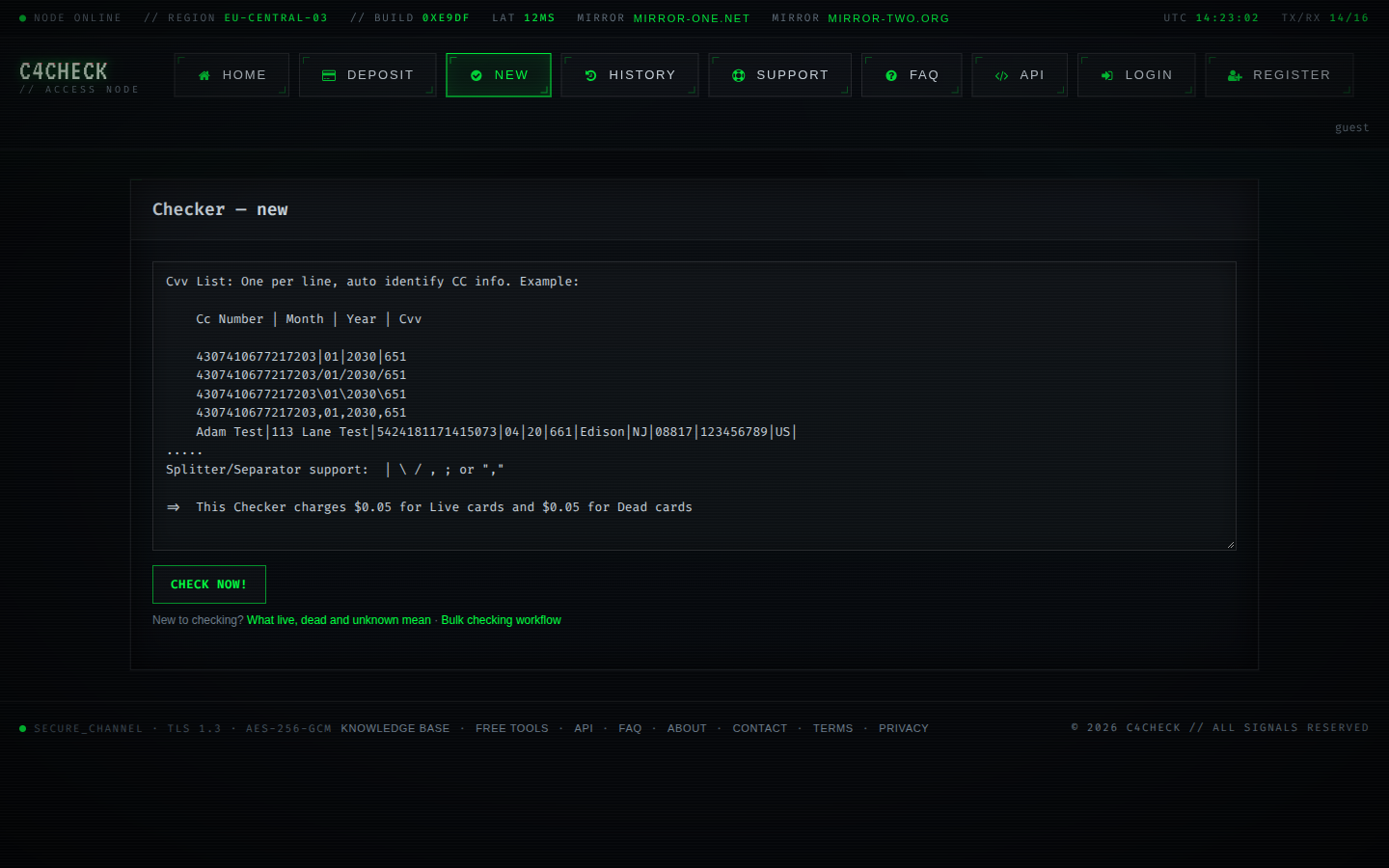
Paste a list of full numbers and the platform batches them, keeps multiple checks in flight and streams each result the moment it is classified. Local format validation (Luhn + length + expiry) runs first so malformed rows never spend a check. For very large files use the bulk CC checker workflow or the verification script.
CCN checking via API
Automate CCN checks with the REST API: send the number with your key, receive the classification and remaining balance. Start with the integration guide or the API reference.
Security
CCNs are sensitive. Only verify cards you own or are authorised to process, never store security codes after use, and remember that our platform never writes card data to application logs. See the terms and privacy policy.
CCN checker and CC checker describe the same tool; CCN is the shorter label used in some communities for the card-number check. The engine behind both is identical: a request to the issuer through a configured gateway, classified into live, dead, unknown or error.
What matters operationally is not the acronym but the workflow around it — clean input, sized batches, a fallback route, and a defined action for every outcome. The platform applies that workflow uniformly whether you arrive via the CCN, CC or CVV entry point.
Key points about CCN checking
- CCN and CC refer to the same verification engine
- Outcomes are live, dead, unknown or error
- The workflow around the tool decides the results' value
- Free tools prepare input; paid checks classify it
The mechanics behind CCN checking
The platform keeps one history row per request with status, cost and before/after balance, which makes the whole loop auditable at the individual check level. Nothing in the check moves money: the request asks a question, the issuer answers, and the platform records one of four outcomes against your account. The four outcomes are categorical rather than numeric because decisions are categorical too: proceed, recover, retry or log. Error means the check itself failed technically: a timeout, a provider fault or malformed input. No classification was produced, and no charge applies. Write it down; CCN checking workflows live and die on small consistencies.
Rate limits, formats and latency all come from the provider side, which is why per-gateway configuration exists instead of one global setting. Checks are routed through providers rather than card networks directly, so the same card can behave differently on different routes. A verification answer reflects the issuer's view at the moment of the request; nothing about it changes the card, the account or the cardholder. Keep it in mind whenever CCN checking results are reviewed.
Running CCN checking well: the operating steps
Watch two numbers over time: the classified rate and the error rate. Together they explain almost every surprise in monthly spend. Validate checksums and expiry dates before any paid request; the free browser tools exist precisely so malformed rows never reach a provider. Size batches to the provider ceiling. Past that line, extra concurrency converts into timeouts rather than throughput. Start with a pilot of fifty cards. It surfaces format mismatches and routing surprises while the cost of being wrong is still measured in cents. Keep it in mind whenever CCN checking results are reviewed.
Reading CCN checking results honestly
When a result contradicts other evidence, re-check once after a reasonable interval rather than assuming the checker is wrong. Classified rate is the share of cards that produce a definitive answer; it is the first number to compare when switching gateways. The four result classes are a decision matrix, not a score: live proceeds, dead recovers, unknown gets one careful retry, error returns to the queue. Errors are free by design: no classification means no charge, so retrying after fixing the cause costs nothing but effort. It is a small rule that changes how CCN checking behaves at scale.
Running CCN checking as a process
A written triage table — one action per result class — keeps large runs mechanical and auditable. Keep one primary gateway and one fallback, and switch on evidence — error spikes and classified-rate drops — rather than on price alone. Track cost per classified card rather than cost per request; it is the only metric that reflects retries and unknown rates. Alert on classified-rate drops, not just on errors; silent degradation is the expensive kind. In CCN checking work, that is the difference between a signal and a guess.
Using CCN checking on the right side of the line
Verification is a signal, not a guarantee: a live result does not promise that a later charge will be approved. Verification is at its best when it is boring: a routine status step inside an existing, authorised process. Check only cards you own or are authorised to process; verification is not a shortcut around cardholder authorization. In CCN checking work, that is the difference between a signal and a guess.
Funding and costs around CCN checking
The real cost metric is cost per classified card, because it folds in retries and unknown rates. History records cost and before/after balance for every check, making spend auditable at the individual row. A deposit address is generated per invoice, and confirmation progress is visible in real time on the deposit page. A small buffer in the balance buys continuity; running to zero mid-list buys a mess. Remember it the next time CCN checking produces an ambiguous answer.
Handling keys and data in CCN checking
Log identifiers and outcomes, not card numbers. Debugging almost never requires a PAN. The dashboard shows the key once and lets you rotate it at will; rotation is cheap, leaks are not. Encrypted transport and account-scoped access are defaults; nothing about the integration requires changing them. API keys are server-side secrets: they belong in environment configuration, never in URLs, logs or client bundles. That distinction is what keeps CCN checking decisions clean.
Measured behaviour of CCN checking
Cost per classified card is the honest metric. A cheap-per-request route with a high failure rate is the most expensive option in practice. Trends beat snapshots: a classified rate that drifts over weeks says more than any single run's result. The platform publishes outcome distributions and latency percentiles from real traffic, refreshed monthly, precisely so expectations can be calibrated against reality. Sample sizes matter. Small windows produce noisy percentages, which is why published aggregates carry minimum thresholds. Keep it in mind whenever CCN checking results are reviewed.
Common mistakes around CCN checking
Running CCN checking without a fallback means one degraded provider turns an entire batch into unknowns. Running CCN checking without a written triage rule turns a clean batch into manual archaeology. Chasing every unknown in CCN checking with unlimited retries costs more than classifying the rest of the list.
- Treating an error as a dead card in CCN checking throws away cards that were never classified, and errors are the cheapest outcomes to recover.
- Assuming every CCN checking gateway covers every brand is the fastest way to a list full of errors.
- Scheduling CCN checking after the decision it informs removes most of its value.
- Mixing test numbers into production CCN checking lists creates results that mean nothing.
Boundaries of CCN checking
Check only cards you own or are authorised to process; verification is not a shortcut around cardholder authorization. Verification is at its best when it is boring: a routine status step inside an existing, authorised process. When a proposed use cannot be explained to a compliance reviewer in one sentence, it is probably not a fit. Holding that line is what makes CCN checking reliable over time.
The toolkit around CCN checking
BIN search and IIN lookup answer the issuer question — brand, type, bank, country — without touching account status. The check-digit calculator shows the Luhn math step by step, useful when building or debugging number generation. Every browser tool runs client-side: input never leaves the page, which keeps format validation free and private. Keep it in mind whenever CCN checking results are reviewed.