KEY TAKEAWAYS
- Clean and deduplicate before spending checks.
- Throughput = concurrency × 3600 / latency, capped per gateway.
- Stream results to act immediately; retry only errors.
- Optimise cost per classified card, not price per request.
- Live means active now — a snapshot, not a guarantee for a future charge.
- History retains bulk checking results for the retention window, then purges them.
A bulk CC checker is the difference between checking a handful of cards and running tens of thousands without wasting balance. The workflow below is the one our platform uses and the one we recommend for any large list.
1. Clean before you spend
Deduplicate, strip separators and validate format locally first — the CSV list cleaner does this entirely client-side. Typical raw lists carry 10–30% noise that never deserves a check.
2. Size the pipeline
Throughput is concurrency × 3600 / median latency, capped by each gateway's ceiling. The admin capacity recommendation gives a safe starting point; increase slowly while watching the error rate. The full math is in throughput planning.
3. Stream, don't wait
Results appear as each card classifies. The first result lands in seconds even for very large lists, so live cards can be acted on immediately. See streaming results.
4. Retry only errors
Errors are transport/provider failures — never billed, always retryable. Dead cards are final; retrying them changes nothing. Fallback routing already retries transient failures on a second gateway before an error is returned — see CC gateway routing.
5. Track cost per classified card
The only metric that matters for bulk work: total spend divided by usable results. Dedupe, retry errors only and prefer gateways with high classification quality. See cost per classified card.
Ready-made tooling
- Bulk checking workflow guide — end-to-end checklist.
- Bulk verification script — CSV in, classified CSV out.
- REST API — automate with bounded concurrency.
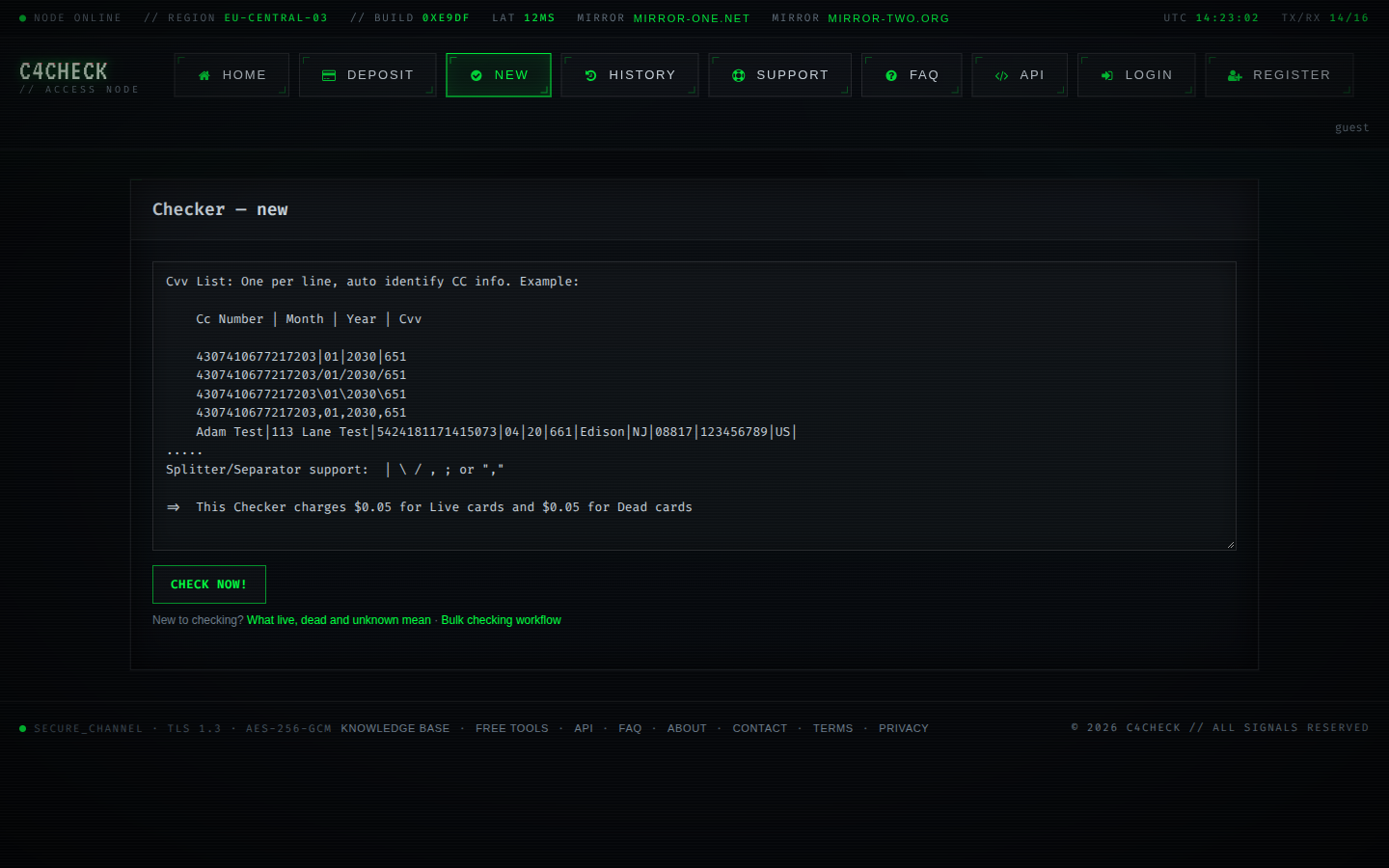
The bulk CC checker is built for lists: paste thousands of entries, run them with sized batches and configured parallelism, and watch classifications stream in. The interface stays responsive because results are handled as they arrive rather than collected at the end.
Three preparation steps determine the run's quality: validate checksums and expiry, deduplicate rows, and confirm the input format matches the selected gateway. Everything after that is triage, and the platform provides the per-result actions the workflow needs.
Key points about bulk checking
- Designed for large lists with streaming output
- Validate, deduplicate, then submit
- Size batches to provider tolerances
- Triage live/dead/unknown/error as they stream
Bulk checking: from request to result
Live means the issuer answered and the account is active and chargeable at that moment; it is strong evidence, not a promise about a future charge. Rate limits, formats and latency all come from the provider side, which is why per-gateway configuration exists instead of one global setting. Behind the scenes, every check follows the same chain: your input, the gateway format, the provider connection, the issuer response and the classification you see. A check sends an authorization-shaped request through a provider to the issuer and classifies the reply into one of four states: live, dead, unknown or error. Keep it in mind whenever bulk checking results are reviewed.
The four outcomes are categorical rather than numeric because decisions are categorical too: proceed, recover, retry or log. A verification answer reflects the issuer's view at the moment of the request; nothing about it changes the card, the account or the cardholder. Nothing in the check moves money: the request asks a question, the issuer answers, and the platform records one of four outcomes against your account. It is a small rule that changes how bulk checking behaves at scale.
Running bulk checking well: the operating steps
Start with a pilot of fifty cards. It surfaces format mismatches and routing surprises while the cost of being wrong is still measured in cents. Log request identifiers and outcomes, never full card numbers. Debugging rarely needs a PAN, and storing one is a liability. Deduplicate before submitting: the same card in a list twice is billed twice if both copies classify. Validate checksums and expiry dates before any paid request; the free browser tools exist precisely so malformed rows never reach a provider. That single habit separates routine bulk checking from expensive bulk checking.
Interpreting outcomes in bulk checking
A live answer is evidence about the account, not a guarantee about a specific future transaction; issuer rules can change between the check and the charge. When a result contradicts other evidence, re-check once after a reasonable interval rather than assuming the checker is wrong. Two metrics describe any run: how many cards classify, and how long the pass takes. Everything else is commentary. Dead results are conclusive for the moment and should never be re-checked in the same run; retries on dead cards spend balance for identical answers. It is a small rule that changes how bulk checking behaves at scale.
Running bulk checking as a process
Track cost per classified card rather than cost per request; it is the only metric that reflects retries and unknown rates. Reconcile spend monthly against classified results; the difference between the two numbers is where retries hide. Keep one primary gateway and one fallback, and switch on evidence — error spikes and classified-rate drops — rather than on price alone. Document the route, the batch policy and the retry rules next to each production run; six months later that note is the diagnosis. The habit costs nothing and removes a recurring class of mistakes.
Limits and responsible use of bulk checking
Check only cards you own or are authorised to process; verification is not a shortcut around cardholder authorization. A check does not move money, does not create a charge and does not touch the cardholder's credit file. Verification is a signal, not a guarantee: a live result does not promise that a later charge will be approved. The habit costs nothing and removes a recurring class of mistakes.
The economics of bulk checking
History records cost and before/after balance for every check, making spend auditable at the individual row. A deposit address is generated per invoice, and confirmation progress is visible in real time on the deposit page. The real cost metric is cost per classified card, because it folds in retries and unknown rates. A small buffer in the balance buys continuity; running to zero mid-list buys a mess. That distinction is what keeps bulk checking decisions clean.
Handling keys and data in bulk checking
The dashboard shows the key once and lets you rotate it at will; rotation is cheap, leaks are not. API keys are server-side secrets: they belong in environment configuration, never in URLs, logs or client bundles. Encrypted transport and account-scoped access are defaults; nothing about the integration requires changing them. Log identifiers and outcomes, not card numbers. Debugging almost never requires a PAN. It sounds obvious until a real run tests it.
What aggregate data says about bulk checking
Sample sizes matter. Small windows produce noisy percentages, which is why published aggregates carry minimum thresholds. The platform publishes outcome distributions and latency percentiles from real traffic, refreshed monthly, precisely so expectations can be calibrated against reality. Trends beat snapshots: a classified rate that drifts over weeks says more than any single run's result. Cost per classified card is the honest metric. A cheap-per-request route with a high failure rate is the most expensive option in practice. It is a small rule that changes how bulk checking behaves at scale.
Common mistakes around bulk checking
Running bulk checking without a fallback means one degraded provider turns an entire batch into unknowns. Letting duplicates through the input during bulk checking pays twice for the same answer. Running bulk checking without a written triage rule turns a clean batch into manual archaeology.
- Scheduling bulk checking after the decision it informs removes most of its value.
- Mixing test numbers into production bulk checking lists creates results that mean nothing.
- Treating an error as a dead card in bulk checking throws away cards that were never classified, and errors are the cheapest outcomes to recover.
- Skipping format validation before bulk checking turns simple input mistakes into provider rejects that look like card problems.
What bulk checking cannot promise
Verification is at its best when it is boring: a routine status step inside an existing, authorised process. Results describe the account, never the person; they should inform routing and risk decisions, not identity decisions. Operators remain responsible for the legal basis on which they hold and process card data. Remember it the next time bulk checking produces an ambiguous answer.
Free tools that support bulk checking
Pair the generator with the Luhn validator when building test fixtures; checksum-valid numbers exercise real validation paths. The CSV cleaner normalises separators and removes duplicates, which is the cheapest way to protect a large run. The test card generator produces checksum-valid numbers for development, and they are never chargeable by design. The habit costs nothing and removes a recurring class of mistakes.
- Luhn validator
- expiry checker
- Bulk Card Checking Guide
- Bulk Card Verification Script
- Cost Per Classified Card
- Cc Checker