KEY TAKEAWAYS
- Free issuer-range metadata endpoint, no key required.
- Returns brand, type, bank and country for 327k+ ranges.
- Reference metadata only — not account status.
- Powers the BIN search and generator tools.
- Fund before long runs; interrupted the BIN checker API runs are the expensive kind.
- One primary gateway plus one fallback keeps the BIN checker API resilient.
The BIN reference endpoint is free and does not require a key. It returns public issuer-range metadata — never account status.
Lookup
GET /api/public/bins.php?action=lookup&bin=414720Response includes brand, card type, issuing bank, country and country code.
Filters
?action=countries— all countries with range counts.?action=brands— all brands with range counts.?action=banks&country=US&brand=Visa— issuing banks.?action=bins&country=US&brand=Visa&bank=CHASE— ranges for generation/testing.
How to use it responsibly
- BIN data identifies the issuer range, not the cardholder or account status.
- Combine with 8-digit IIN awareness for modern ranges.
- For status, run a live check through the main API.
The same endpoint powers our free BIN search tool and the test card generator advanced mode.
The BIN checker API returns issuer reference data for leading card digits — brand, type, bank and country — without touching account status. It is the programmatic form of the BIN tools: read-only, fast, and free of any card-network request.
Typical uses are enrichment and routing: label incoming numbers with issuer metadata, route by brand or country, and pre-fill display fields. For status questions, pair it with a live check; the two answer different layers and are designed to be used together.
Key points about the BIN checker API
- Reference metadata: brand, type, bank, country
- No status claims; pair with live checks for that
- Ideal for enrichment and routing logic
- Public, read-only endpoint documented in the OpenAPI spec
Working with the the BIN checker API integration
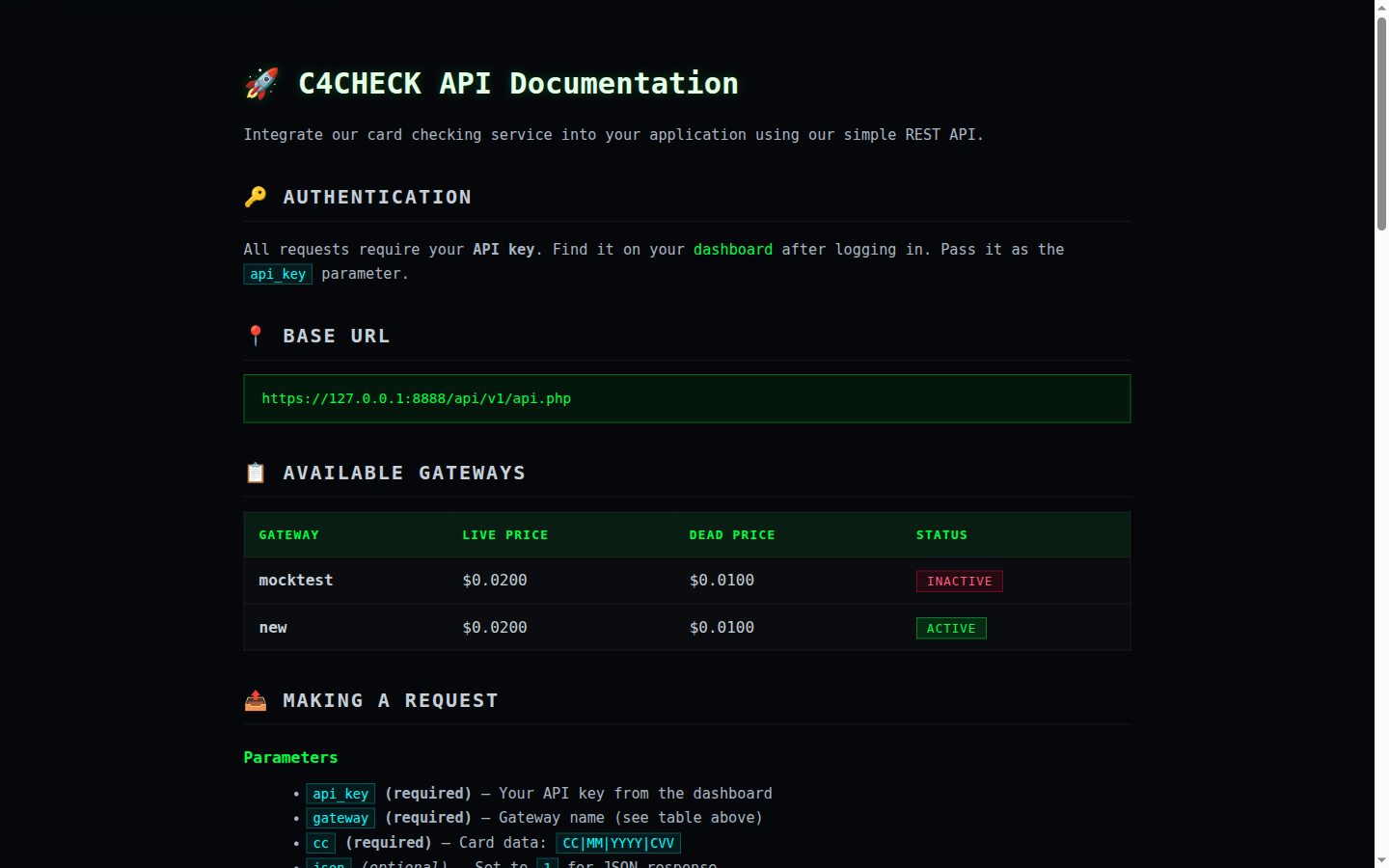
Authenticate with the API key in a request header; a key in a URL or in client-side code is a leak waiting to happen. Add a circuit breaker: when the error rate crosses a threshold, pause the run and move the remainder to the fallback route. Automation pays off on scheduled workloads: card-on-file audits and route health checks are the classic candidates. Regenerating the key takes one click on the dashboard and invalidates the old one immediately. The habit costs nothing and removes a recurring class of mistakes.
Keeping the BIN checker API secure
Encrypted transport and account-scoped access are defaults; nothing about the integration requires changing them. API keys are server-side secrets: they belong in environment configuration, never in URLs, logs or client bundles. The dashboard shows the key once and lets you rotate it at will; rotation is cheap, leaks are not. Log identifiers and outcomes, not card numbers. Debugging almost never requires a PAN. That distinction is what keeps the BIN checker API decisions clean.
Reading the BIN checker API results honestly
- In the BIN checker API, live results route forward: billing, approval or completion, depending on the workflow.
- Unknown results in the BIN checker API get one fallback pass on a second route, then a defined resting state.
- Dead results in the BIN checker API route to recovery: dunning, an update-payment prompt or list cleanup.
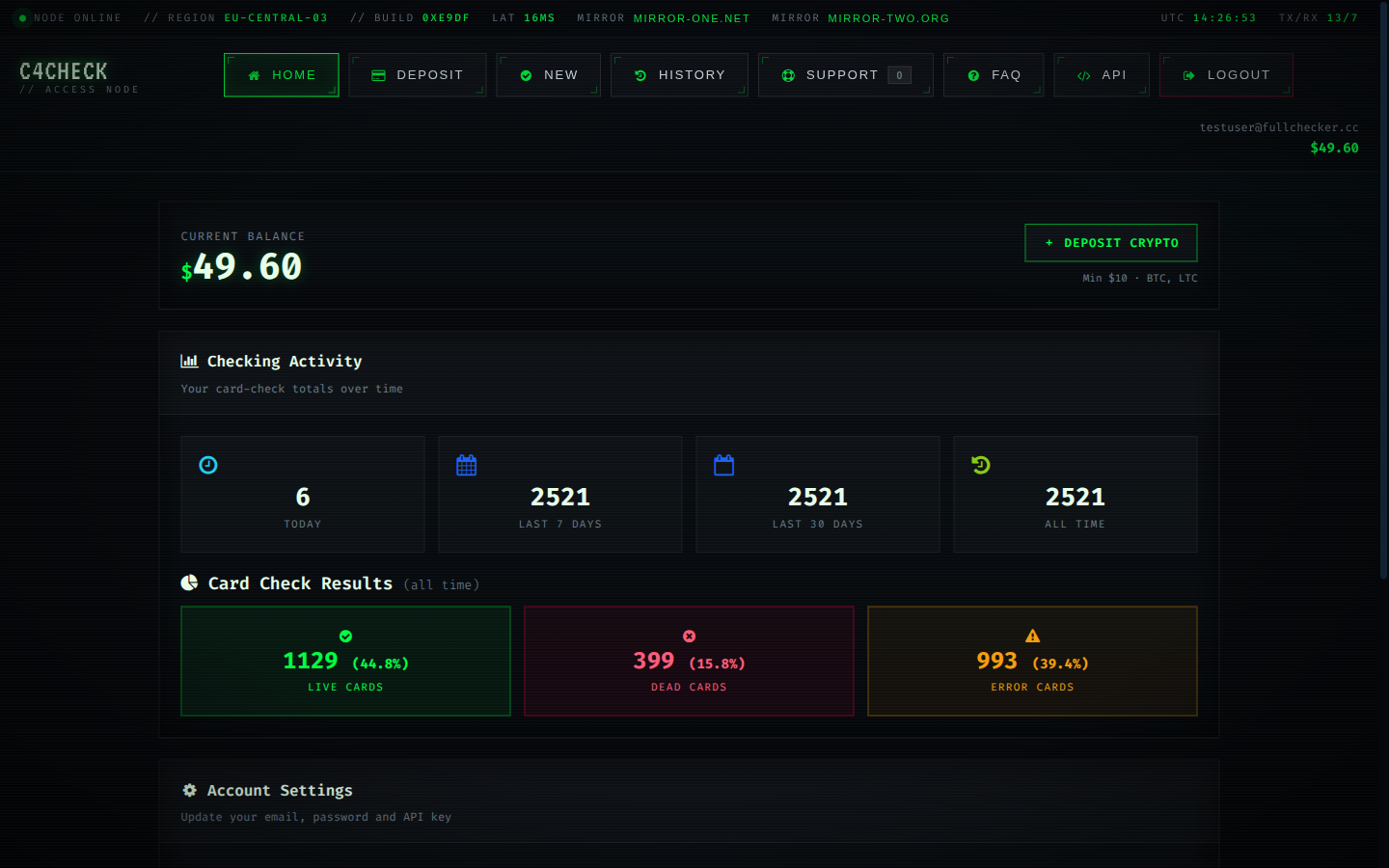
- Errors in the BIN checker API return to the queue after the cause is fixed, because they produced no answer at all.
A live answer is evidence about the account, not a guarantee about a specific future transaction; issuer rules can change between the check and the charge. A result is only as fresh as its timestamp. High-value decisions should use checks that ran close to the moment of the decision. The honest reading of unknown is "no answer yet". The card is neither good nor bad, and the remedy is a different route, not a repeat of the same one. Holding that line is what makes the BIN checker API reliable over time.
A working routine for the BIN checker API
Size batches to the provider ceiling. Past that line, extra concurrency converts into timeouts rather than throughput. When results look wrong, diagnose in order: input format, route, provider health, and only then the cards themselves. Run one primary gateway with a fallback route. When the primary degrades, re-run only the unclassified remainder on the fallback. Log request identifiers and outcomes, never full card numbers. Debugging rarely needs a PAN, and storing one is a liability. Holding that line is what makes the BIN checker API reliable over time.
Using the BIN checker API on the right side of the line
Operators remain responsible for the legal basis on which they hold and process card data. Where a check is used inside a payment flow, it complements authorization rather than replacing it. The platform does not trade card data, and nothing in the system is designed to bypass a cardholder's consent. Keep it in mind whenever the BIN checker API results are reviewed.
Operating the BIN checker API at scale
Document the route, the batch policy and the retry rules next to each production run; six months later that note is the diagnosis. Schedule recurring checks ahead of the decisions they inform, not after them. Keep the API key server-side and regenerable; a leaked key is a billing incident as much as a security one. Reconcile spend monthly against classified results; the difference between the two numbers is where retries hide. Holding that line is what makes the BIN checker API reliable over time.
Interpreting outcomes in the BIN checker API
Classified rate is the share of cards that produce a definitive answer; it is the first number to compare when switching gateways. A live answer is evidence about the account, not a guarantee about a specific future transaction; issuer rules can change between the check and the charge. Two metrics describe any run: how many cards classify, and how long the pass takes. Everything else is commentary. Conflating outcomes is the most expensive habit in this area — an error treated as a dead card discards real inventory, and an unknown treated as live inflates confidence. It sounds obvious until a real run tests it.
The BIN checker API in numbers
The platform publishes outcome distributions and latency percentiles from real traffic, refreshed monthly, precisely so expectations can be calibrated against reality. Trends beat snapshots: a classified rate that drifts over weeks says more than any single run's result. Cost per classified card is the honest metric. A cheap-per-request route with a high failure rate is the most expensive option in practice. Sample sizes matter. Small windows produce noisy percentages, which is why published aggregates carry minimum thresholds. It sounds obvious until a real run tests it.
Failure modes to design out of the BIN checker API
Letting duplicates through the input during the BIN checker API pays twice for the same answer. Treating an error as a dead card in the BIN checker API throws away cards that were never classified, and errors are the cheapest outcomes to recover. Re-checking live cards during the BIN checker API spends balance without changing any decision.
- Running the BIN checker API without a written triage rule turns a clean batch into manual archaeology.
- Chasing every unknown in the BIN checker API with unlimited retries costs more than classifying the rest of the list.
- Comparing the BIN checker API routes on list price instead of classified rate hides the real economics.
- Treating an error as a dead card in the BIN checker API throws away cards that were never classified, and errors are the cheapest outcomes to recover.
Using the BIN checker API on the right side of the line
A check does not move money, does not create a charge and does not touch the cardholder's credit file. Operators remain responsible for the legal basis on which they hold and process card data. The platform does not trade card data, and nothing in the system is designed to bypass a cardholder's consent. Write it down; the BIN checker API workflows live and die on small consistencies.
Keeping the BIN checker API predictable
Schedule recurring checks ahead of the decisions they inform, not after them. Keep the API key server-side and regenerable; a leaked key is a billing incident as much as a security one. Budget verification against the cost of failure, not against zero; the comparison is what makes spend defensible. Treat provider outages as routing problems: switch routes, recover the unclassified remainder, keep the answers you already paid for. Keep it in mind whenever the BIN checker API results are reviewed.