KEY TAKEAWAYS
- Errors are usually input, congestion or provider problems — not bad cards.
- Validate and deduplicate input first.
- Back off concurrency if errors cluster at the end of runs.
- Use fallback gateways and retry only errors.
- Watch classified rate and latency trends, not just the balance.
- One primary gateway plus one fallback keeps error-rate reduction resilient.
An error means the check produced no usable answer. High error rates are almost always an operational problem: input format, connectivity or gateway congestion. Here is how to diagnose them in the right order.
1. Check the input format
Most "errors" caused by the client are malformed rows: wrong separator, missing month, extra whitespace, card number failing Luhn. A malformed row never reaches the issuer. Validate format client-side, deduplicate and strip passwords or commentary lines before submitting. The bulk guide has a preparation checklist.
2. Look at timing, not counts
If errors cluster at the end of a batch or increase as concurrency rises, the gateway is being saturated. Every provider has a throughput ceiling; past it, requests queue until they time out. Reduce concurrency or chunk size until errors fall, then increase slowly. Our admin capacity probe suggests a starting point for your hardware.
3. Separate unknowns from errors
- Unknown means the issuer answered with a challenge or ambiguous rule. It is a card-side outcome, not a failure.
- Error means no usable answer — connection, timeout or malformed upstream response.
If most of your "errors" are actually unknowns, your workflow needs an unknown handling policy, not a bigger retry budget. See result states explained.
4. Use fallback gateways
Providers have bad minutes. A second gateway configured as fallback catches transient failures without marking cards incorrectly: when the primary times out, the same card is tried on the fallback and only classified if that attempt answers. Good checkers do this automatically.
5. Retry the right rows only
Retry errors, never dead. A retry policy that re-runs every row multiplies load and cost while changing nothing. Keep a small retry budget per batch and a global time limit so a stuck run cannot hang forever.
6. Measure over time
Track error rate per gateway per day. A step change points at the gateway; a gradual rise points at your settings. Your admin performance panel already reports recent outcomes by gateway — use it before blaming the cards.
Error rates are a diagnostic, not a verdict on the provider. High errors usually trace to input format, an oversized batch, a provider incident, or a route that does not cover the card brands in the list. Each cause has a different fix, and only one of them is "change gateways".
The platform separates errors from dead results precisely so this diagnosis stays possible: errors produce no classification and no charge, and they are recoverable on a fallback route after the cause is addressed.
Key points about error-rate reduction
- Check input format before blaming the route
- Reduce concurrency if timeouts dominate
- Match route coverage to the card brands in the list
- Retry errors after fixing the cause — they are free
How error-rate reduction actually works
Error means the check itself failed technically: a timeout, a provider fault or malformed input. No classification was produced, and no charge applies. The four outcomes are categorical rather than numeric because decisions are categorical too: proceed, recover, retry or log. Behind the scenes, every check follows the same chain: your input, the gateway format, the provider connection, the issuer response and the classification you see. Nothing in the check moves money: the request asks a question, the issuer answers, and the platform records one of four outcomes against your account. Remember it the next time error-rate reduction produces an ambiguous answer.
Putting error-rate reduction to work
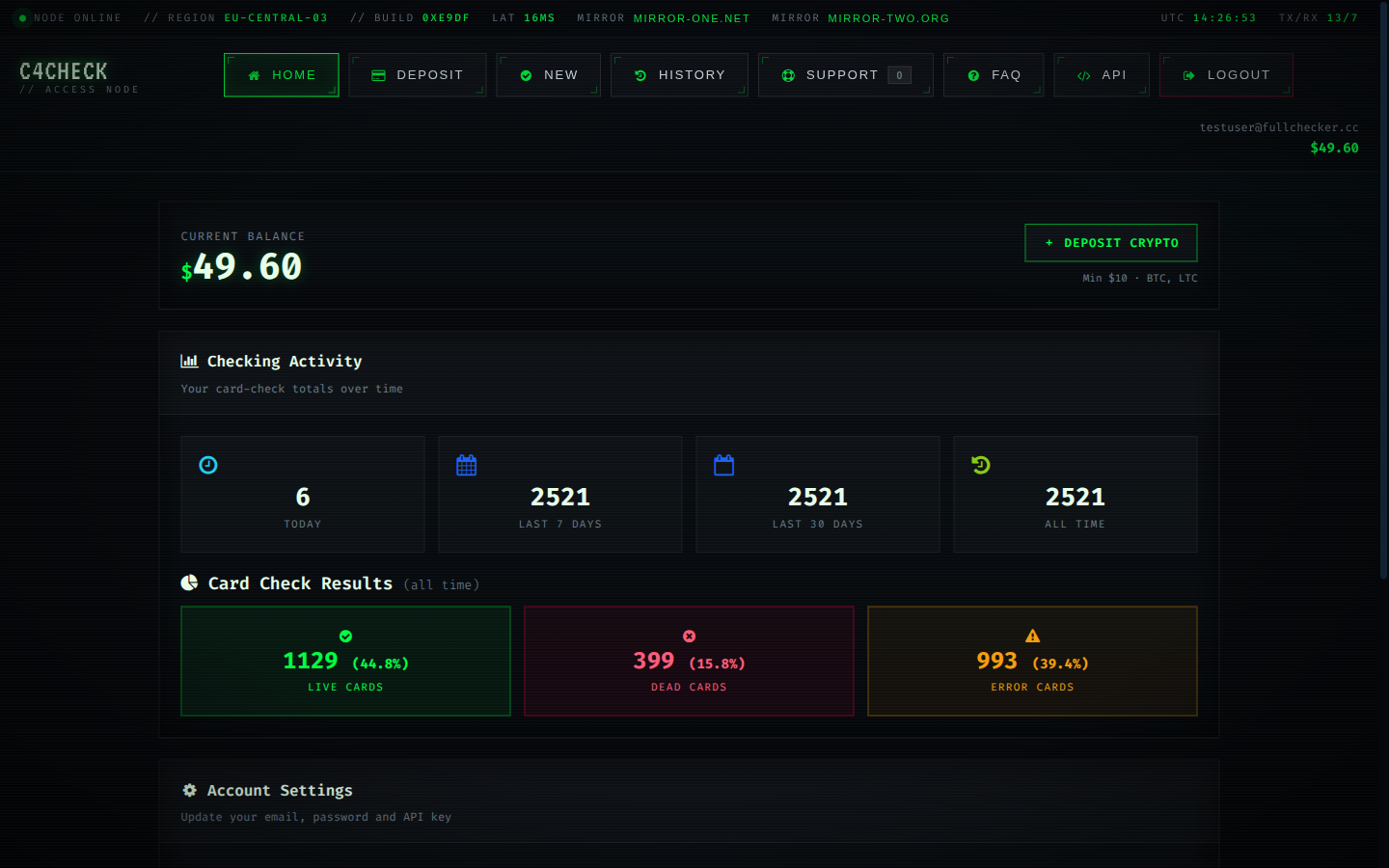
Keep a small balance buffer so an interrupted run never leaves a half-classified list and the temptation to re-check everything. Watch two numbers over time: the classified rate and the error rate. Together they explain almost every surprise in monthly spend. Deduplicate before submitting: the same card in a list twice is billed twice if both copies classify. Decide how each outcome is handled before the run starts; a triage plan written after the results arrive is usually just a spreadsheet. It sounds obvious until a real run tests it.
Interpreting outcomes in error-rate reduction
Two metrics describe any run: how many cards classify, and how long the pass takes. Everything else is commentary. A result is only as fresh as its timestamp. High-value decisions should use checks that ran close to the moment of the decision. The four result classes are a decision matrix, not a score: live proceeds, dead recovers, unknown gets one careful retry, error returns to the queue. When a result contradicts other evidence, re-check once after a reasonable interval rather than assuming the checker is wrong. The habit costs nothing and removes a recurring class of mistakes.
Keeping error-rate reduction predictable
Treat provider outages as routing problems: switch routes, recover the unclassified remainder, keep the answers you already paid for. Schedule recurring checks ahead of the decisions they inform, not after them. Document the route, the batch policy and the retry rules next to each production run; six months later that note is the diagnosis. Reconcile spend monthly against classified results; the difference between the two numbers is where retries hide. It is a small rule that changes how error-rate reduction behaves at scale.
Using error-rate reduction on the right side of the line
Where a check is used inside a payment flow, it complements authorization rather than replacing it. A check does not move money, does not create a charge and does not touch the cardholder's credit file. Verification is a signal, not a guarantee: a live result does not promise that a later charge will be approved. Keep it in mind whenever error-rate reduction results are reviewed.
The economics of error-rate reduction
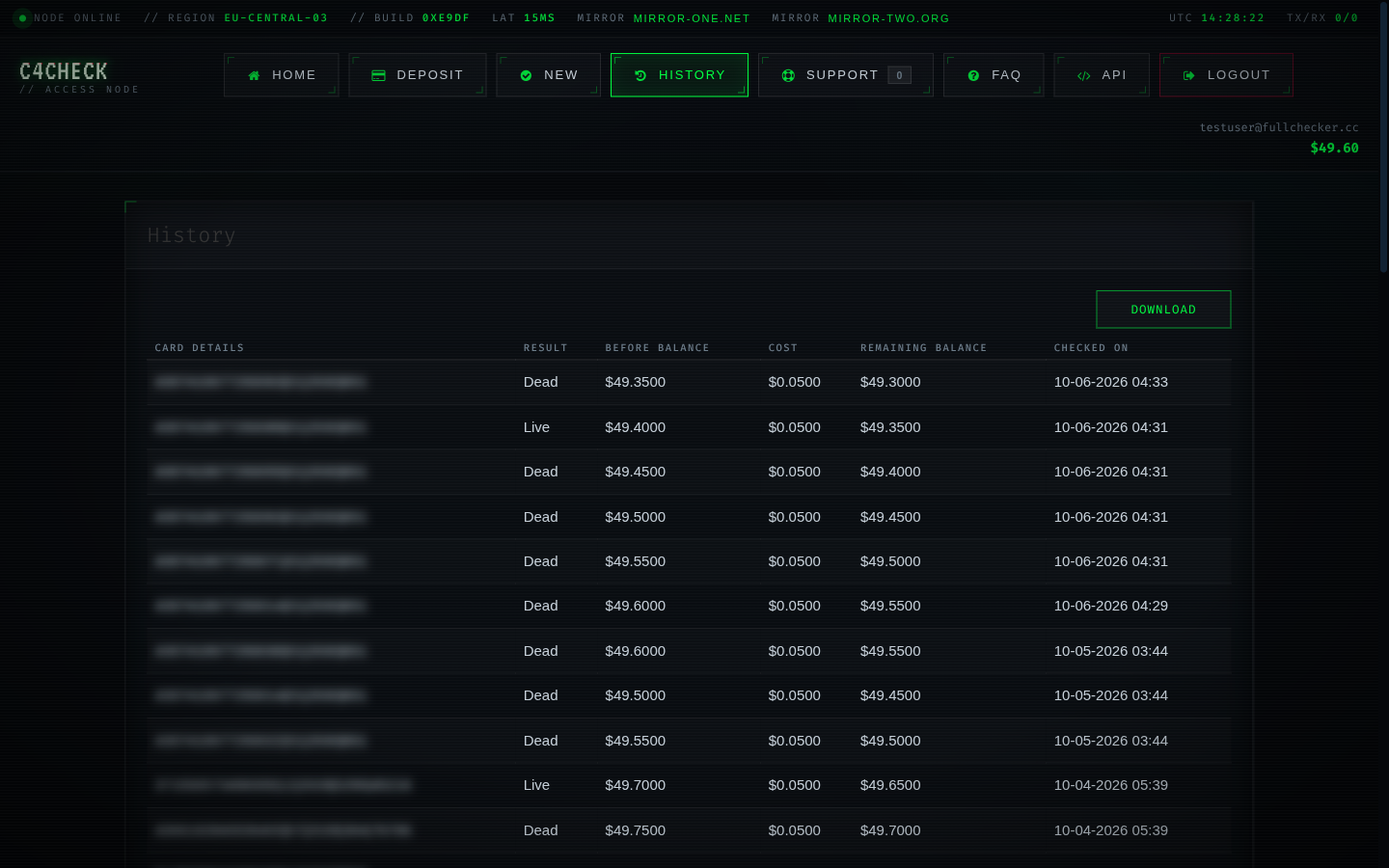
History records cost and before/after balance for every check, making spend auditable at the individual row. A small buffer in the balance buys continuity; running to zero mid-list buys a mess. The real cost metric is cost per classified card, because it folds in retries and unknown rates. A deposit address is generated per invoice, and confirmation progress is visible in real time on the deposit page. Holding that line is what makes error-rate reduction reliable over time.
Keeping error-rate reduction secure
Verification data is operational data — treat it with the same care as any other sensitive business record. Check inputs are account-scoped and retained under the platform retention window, then purged by the scheduled cleanup. Aggregate statistics are computed without exposing individual records, which is why published numbers can be useful without being risky. Regenerate the key the moment compromise is suspected; every check remains attributed in history, so the audit trail survives. It is a small rule that changes how error-rate reduction behaves at scale.
Benchmarks and distribution for error-rate reduction
Latency percentiles matter more than averages: the p90 and p99 tell you what a slow run actually feels like. The reference BIN table covers hundreds of thousands of issuer ranges, and it is deliberately separate from account-status data: one describes issuers, the other describes cards. When the classified rate moves, the cause is usually a route or provider change rather than the underlying cards. Aggregate numbers describe populations, not individual cards. Use them to size timeouts and retry budgets, never to judge one account. In error-rate reduction work, that is the difference between a signal and a guess.
Pitfalls that cost money in error-rate reduction
Increasing parallelism past the provider ceiling in error-rate reduction converts capacity into timeouts. Storing card data beyond the needs of error-rate reduction creates risk without adding value. Treating a error-rate reduction snapshot as permanent truth overstates what verification can promise.
- Comparing error-rate reduction routes on list price instead of classified rate hides the real economics.
- Storing card data beyond the needs of error-rate reduction creates risk without adding value.
- Increasing parallelism past the provider ceiling in error-rate reduction converts capacity into timeouts.
- Ignoring cost per classified card hides the real price of a cheap error-rate reduction route with a high failure rate.