KEY TAKEAWAYS
- One small function catches most input errors client-side.
- Normalize whitespace and dashes before validating.
- Never expose an API key in front-end JavaScript.
- Use Node.js for live status checks.
- Generated test numbers are checksum-valid and never chargeable.
- Unknown deserves one fallback pass, not infinite retries.
Validating card numbers in the browser prevents bad input before any request leaves the page — and the same code runs in Node.js. Here is a dependency-free implementation.
Luhn checksum
function luhnOk(value) {
  const digits = String(value).replace(/\D/g, '');
  if (digits.length < 12 || digits.length > 19) return false;
  let sum = 0;
  let alt = false;
  for (let i = digits.length - 1; i >= 0; i--) {
    let d = Number(digits[i]);
    if (alt) { d *= 2; if (d > 9) d -= 9; }
    sum += d;
    alt = !alt;
  }
  return sum % 10 === 0;
}
Brand detection
const BRANDS = [
  ['visa', /^4/],
  ['mastercard', /^(5[1-5]|2[2-7])/],
  ['amex', /^3[47]/],
  ['discover', /^(6011|64[4-9]|65)/],
  ['jcb', /^35(2[89]|[3-8])/],
  ['diners', /^(36|38|30[0-5])/],
  ['unionpay', /^62/],
];
const brand = (n) => (BRANDS.find(([, re]) => re.test(n)) || [null])[0];
Input pattern
Normalize on input, validate on blur or submit. Never block keystrokes — users paste numbers with spaces and dashes. A good UX: strip separators for validation, format groups of four for display.
Testing
luhnOk('4307410677293014') === trueluhnOk('4307410677293015') === falseluhnOk('4111 1111 1111 1111') === true
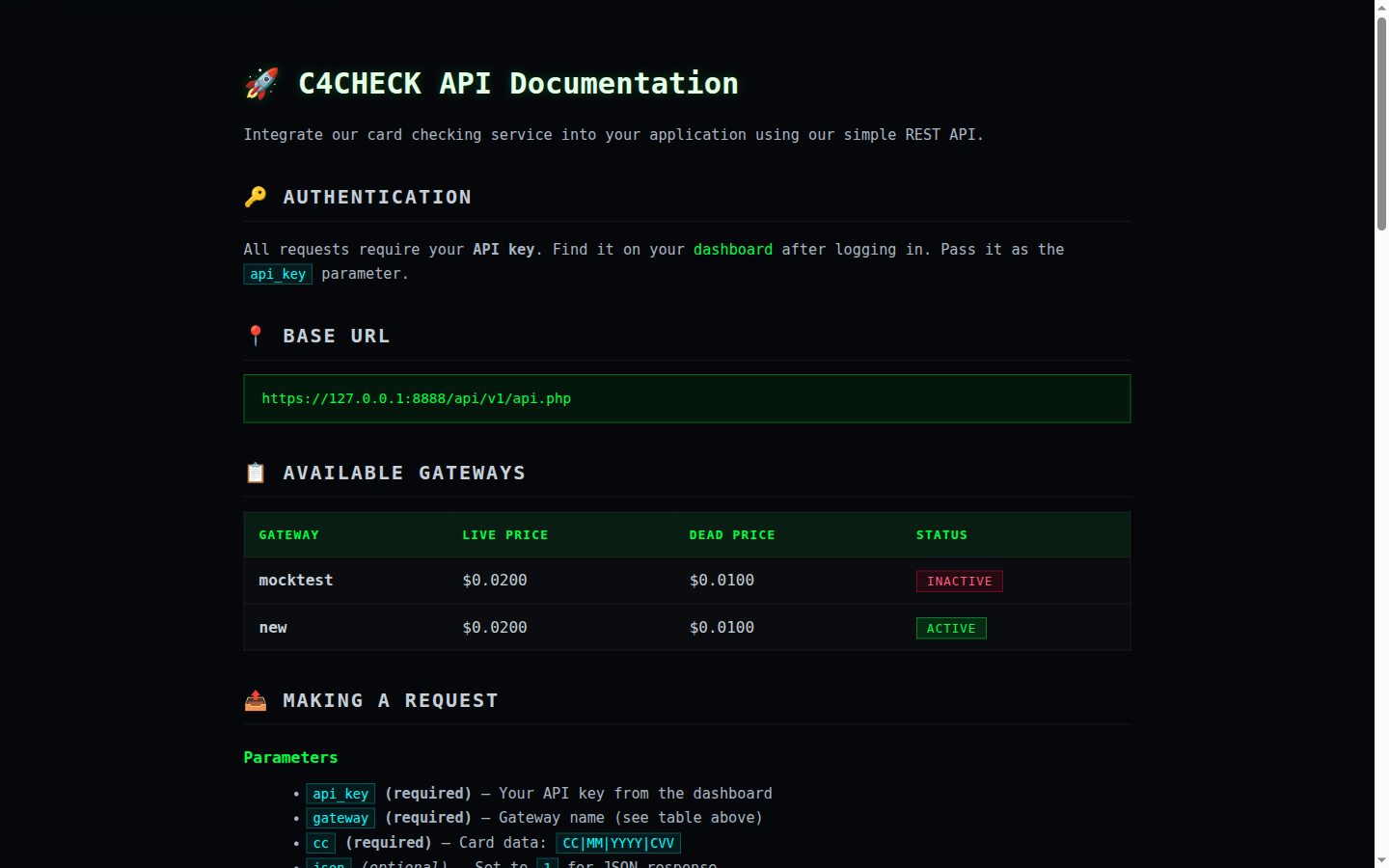
For status beyond format, call a CC checker API server-side — never expose API keys in the browser. See Node.js integration.
The browser-side Luhn check is the first line of defense in any checkout form: it catches typos before a request leaves the page. The same function runs server-side in Node, which keeps client and server validation identical.
The version below ignores non-digits, handles the doubling rule, and returns whether the checksum passes.
A concrete Luhn in JavaScript example
function luhnOk(number) {
  const digits = number.replace(/\D/g, "");
  let sum = 0, alt = false;
  for (let i = digits.length - 1; i >= 0; i--) {
    let d = +digits[i];
    if (alt) { d *= 2; if (d > 9) d -= 9; }
    sum += d; alt = !alt;
  }
  return sum % 10 === 0;
}
Regenerating the key takes one click on the dashboard and invalidates the old one immediately. Authenticate with the API key in a request header; a key in a URL or in client-side code is a leak waiting to happen. A machine-readable OpenAPI description is available for Postman, Insomnia and client generation. Keep it in mind whenever Luhn in JavaScript results are reviewed.
Luhn in JavaScript via the REST API
A machine-readable OpenAPI description is available for Postman, Insomnia and client generation. Reconcile timeout outcomes before assuming failure — the answer may exist even when the response did not arrive. Branch on the result field rather than the HTTP status alone: a successful response can still carry an error outcome. Keep the integration boring: one endpoint, one key, explicit handling for the four result classes. Keep it in mind whenever Luhn in JavaScript results are reviewed.
Security rules for Luhn in JavaScript
The dashboard shows the key once and lets you rotate it at will; rotation is cheap, leaks are not. Encrypted transport and account-scoped access are defaults; nothing about the integration requires changing them. API keys are server-side secrets: they belong in environment configuration, never in URLs, logs or client bundles. Log identifiers and outcomes, not card numbers. Debugging almost never requires a PAN. Holding that line is what makes Luhn in JavaScript reliable over time.
What each Luhn in JavaScript outcome commits you to
- Errors in Luhn in JavaScript return to the queue after the cause is fixed, because they produced no answer at all.
- Dead results in Luhn in JavaScript route to recovery: dunning, an update-payment prompt or list cleanup.
- In Luhn in JavaScript, live results route forward: billing, approval or completion, depending on the workflow.
- Unknown results in Luhn in JavaScript get one fallback pass on a second route, then a defined resting state.
Classified rate is the share of cards that produce a definitive answer; it is the first number to compare when switching gateways. Dead results are conclusive for the moment and should never be re-checked in the same run; retries on dead cards spend balance for identical answers. Two metrics describe any run: how many cards classify, and how long the pass takes. Everything else is commentary. Remember it the next time Luhn in JavaScript produces an ambiguous answer.
Putting Luhn in JavaScript to work
When results look wrong, diagnose in order: input format, route, provider health, and only then the cards themselves. Deduplicate before submitting: the same card in a list twice is billed twice if both copies classify. Treat every large list as two lists: the part that classifies on the first pass, and the remainder that needs a decision about how hard to chase. Keep a small balance buffer so an interrupted run never leaves a half-classified list and the temptation to re-check everything. Remember it the next time Luhn in JavaScript produces an ambiguous answer.
Using Luhn in JavaScript on the right side of the line
The platform does not trade card data, and nothing in the system is designed to bypass a cardholder's consent. Operators remain responsible for the legal basis on which they hold and process card data. Check only cards you own or are authorised to process; verification is not a shortcut around cardholder authorization. Remember it the next time Luhn in JavaScript produces an ambiguous answer.
Operating Luhn in JavaScript at scale
A written triage table — one action per result class — keeps large runs mechanical and auditable. Alert on classified-rate drops, not just on errors; silent degradation is the expensive kind. Budget verification against the cost of failure, not against zero; the comparison is what makes spend defensible. Treat provider outages as routing problems: switch routes, recover the unclassified remainder, keep the answers you already paid for. The habit costs nothing and removes a recurring class of mistakes.
From Luhn in JavaScript result to decision
Two metrics describe any run: how many cards classify, and how long the pass takes. Everything else is commentary. Classified rate is the share of cards that produce a definitive answer; it is the first number to compare when switching gateways. A result is only as fresh as its timestamp. High-value decisions should use checks that ran close to the moment of the decision. The four result classes are a decision matrix, not a score: live proceeds, dead recovers, unknown gets one careful retry, error returns to the queue. Write it down; Luhn in JavaScript workflows live and die on small consistencies.
Measured behaviour of Luhn in JavaScript
The reference BIN table covers hundreds of thousands of issuer ranges, and it is deliberately separate from account-status data: one describes issuers, the other describes cards. Latency percentiles matter more than averages: the p90 and p99 tell you what a slow run actually feels like. When the classified rate moves, the cause is usually a route or provider change rather than the underlying cards. Aggregate numbers describe populations, not individual cards. Use them to size timeouts and retry budgets, never to judge one account. Keep it in mind whenever Luhn in JavaScript results are reviewed.