KEY TAKEAWAYS
- Discover uses 6011, 64[4-9], 65 with 16–19 digits.
- Security code: 3 digits (back).
- Format checks are free; live status needs an issuer check.
- Validate locally first to avoid spending checks on bad rows.
- Live means active now — a snapshot, not a guarantee for a future charge.
- Generated test numbers are checksum-valid and never chargeable.
Every network has its own number format — Discover included. This page covers the format facts you need for correct validation, and how to verify live status beyond the format.
Discover format at a glance
| Property | Value |
|---|---|
| Prefix / IIN ranges | 6011, 64[4-9], 65 |
| Number length | 16–19 digits |
| Security code | 3 digits (back) |
| Checksum | Luhn (mod 10) |
What is specific about Discover
- Discover shares part of its range (622126–622925) with UnionPay co-badged products, so a 62-prefixed number can be either network.
- Most Discover cards are 16 digits, but the network supports up to 19 — length-only validators should allow the wider bound.
- Discover acceptance varies by region; a live check tells you account status regardless of where you process.
Validating and verifying
Bulk Discover lists
Discover operates as both issuer and network in the United States and through partner arrangements elsewhere, and that dual nature shows up in verification: domestic Discover checks resolve more predictably than cross-border ones, where routing through partner networks adds unknowns.
Prefixes begin with 6011, 644–649 and 65. Coverage varies by gateway, and a route that does not support Discover returns errors — which say nothing about the cards. Confirm support first, then classify.
What is different about Discover
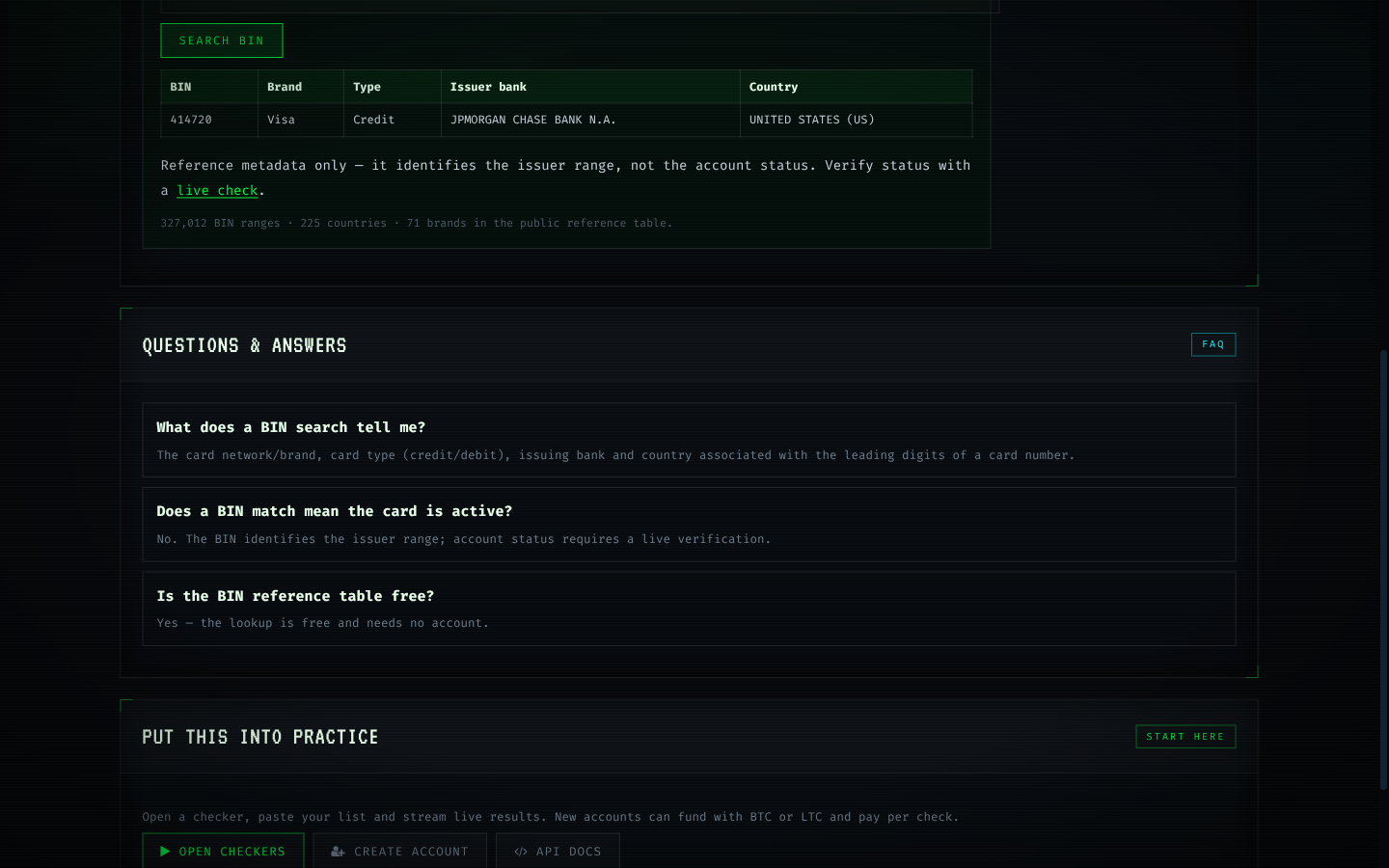
The reference data holds Discover ranges across many issuing banks, and the BIN tools expose them directly. Reference metadata for Discover tells you the issuer and type; only a live check reveals whether the account is active. When a Discover check returns error, suspect the format or the route first — the card is still unclassified. Discover behaviour is shaped by both the network and the issuing bank, which is why two cards with the same brand can resolve differently. Keep it in mind whenever Discover card checking results are reviewed.
Reference lookups in Discover card checking
BIN data answers who issued a number and what kind of card it is; status requires a live check. Segmenting by BIN is useful for routing, risk rules and analytics — the places where issuer identity changes behavior. Issuers move portfolios between banks and reissue ranges, so BIN data ages and should be refreshed from maintained sources. BIN metadata complements verification rather than replacing it: reference first, status second. That single habit separates routine Discover card checking from expensive Discover card checking.
Putting Discover card checking to work
Validate checksums and expiry dates before any paid request; the free browser tools exist precisely so malformed rows never reach a provider. Log request identifiers and outcomes, never full card numbers. Debugging rarely needs a PAN, and storing one is a liability. Start with a pilot of fifty cards. It surfaces format mismatches and routing surprises while the cost of being wrong is still measured in cents. Watch two numbers over time: the classified rate and the error rate. Together they explain almost every surprise in monthly spend. That single habit separates routine Discover card checking from expensive Discover card checking.
Reading Discover card checking results honestly
Dead results are conclusive for the moment and should never be re-checked in the same run; retries on dead cards spend balance for identical answers. Conflating outcomes is the most expensive habit in this area — an error treated as a dead card discards real inventory, and an unknown treated as live inflates confidence. When a result contradicts other evidence, re-check once after a reasonable interval rather than assuming the checker is wrong. The four result classes are a decision matrix, not a score: live proceeds, dead recovers, unknown gets one careful retry, error returns to the queue. The habit costs nothing and removes a recurring class of mistakes.
Boundaries of Discover card checking
A check does not move money, does not create a charge and does not touch the cardholder's credit file. Operators remain responsible for the legal basis on which they hold and process card data. When a proposed use cannot be explained to a compliance reviewer in one sentence, it is probably not a fit. It sounds obvious until a real run tests it.
Operating Discover card checking at scale
Alert on classified-rate drops, not just on errors; silent degradation is the expensive kind. Keep one primary gateway and one fallback, and switch on evidence — error spikes and classified-rate drops — rather than on price alone. Budget verification against the cost of failure, not against zero; the comparison is what makes spend defensible. Keep the API key server-side and regenerable; a leaked key is a billing incident as much as a security one. It sounds obvious until a real run tests it.
Where Discover card checking goes wrong
Validating after the paid Discover card checking request, rather than before, doubles the cost of bad input. Retrying a dead card during Discover card checking spends balance for an answer that will not change within the run. Using BIN reference data as account status in Discover card checking confuses two different questions and produces confident, wrong decisions.
- Letting duplicates through the input during Discover card checking pays twice for the same answer.
- Skipping format validation before Discover card checking turns simple input mistakes into provider rejects that look like card problems.
- Chasing every unknown in Discover card checking with unlimited retries costs more than classifying the rest of the list.
- Mixing test numbers into production Discover card checking lists creates results that mean nothing.
Using Discover card checking on the right side of the line
Verification is at its best when it is boring: a routine status step inside an existing, authorised process. Where a check is used inside a payment flow, it complements authorization rather than replacing it. Check only cards you own or are authorised to process; verification is not a shortcut around cardholder authorization. Holding that line is what makes Discover card checking reliable over time.
Measured behaviour of Discover card checking
The reference BIN table covers hundreds of thousands of issuer ranges, and it is deliberately separate from account-status data: one describes issuers, the other describes cards. Aggregate numbers describe populations, not individual cards. Use them to size timeouts and retry budgets, never to judge one account. When the classified rate moves, the cause is usually a route or provider change rather than the underlying cards. Latency percentiles matter more than averages: the p90 and p99 tell you what a slow run actually feels like. It is a small rule that changes how Discover card checking behaves at scale.