KEY TAKEAWAYS
- Free forever: Luhn, BIN search, expiry, IBAN, test-card generation.
- New-user promotion grants free live checks while active (above).
- Live checks bill per classified result; errors are free.
- Genuine checking always costs something — free "live" checkers are simulated.
- AVS adds a second dimension where the route supports it.
- Store outcomes and identifiers, never PANs, in checking with a zero balance logs.
Brand-new accounts start at $0. Here is exactly what you can do without depositing — and what requires balance.
Free tools (forever)
Luhn validation, brand detection, BIN search across 327k ranges, expiry checks, IBAN validation and test-data generation all run in your browser at no cost.
New-user free checks
What requires balance
Live issuer checks cost the provider money, so they are billed per classified result from a prepaid BTC/LTC balance. Errors and unknown results are never charged, and unused holds are released.
Making a first small deposit
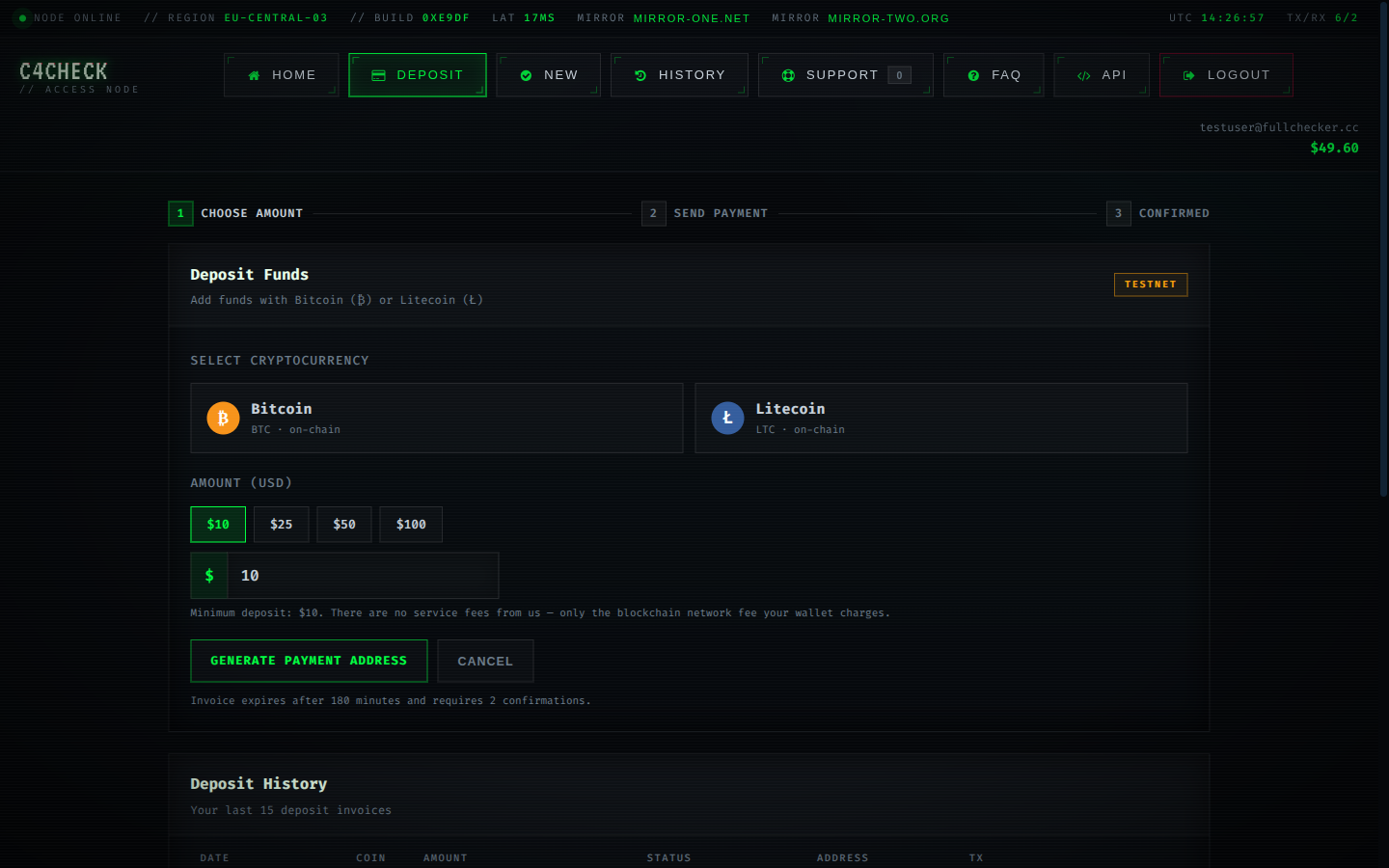
The deposit page generates a BTC/LTC invoice with no service fee from us; even a small deposit funds many checks at typical rates — see pricing.
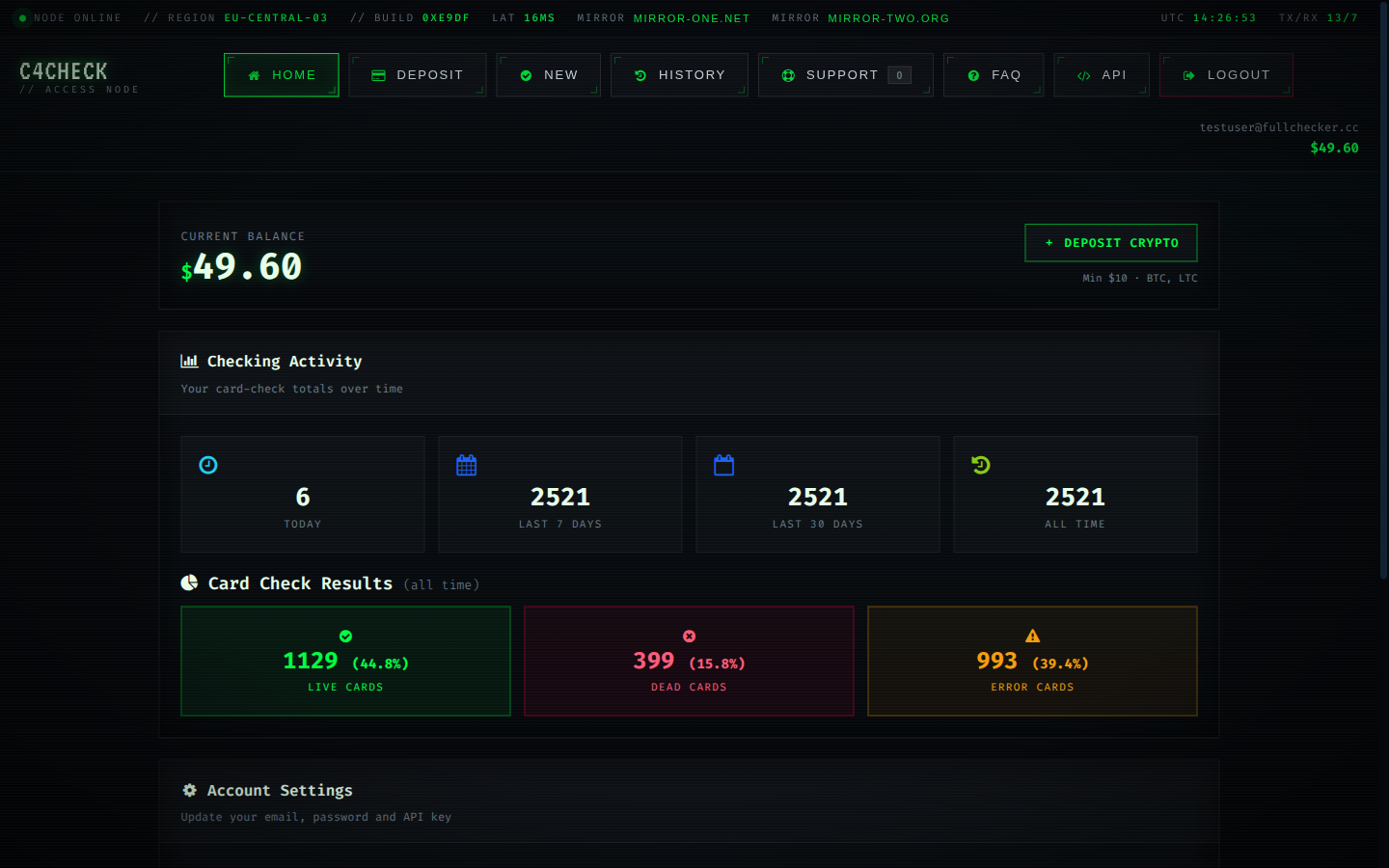
Checking a card is not charging it, so a zero balance on your platform account and a zero balance on the card are two different problems. Your side is simple: verification draws from a prepaid balance, and when the promotion is running, new accounts receive free checks they can spend in the web checker before funding anything.
The cardholder side is subtler. A live result means the account is active and chargeable — it says nothing about whether enough funds are available for a specific amount. Prepaid and debit cards can be active with an empty balance, which is why a later charge can still fail even after a clean live result.
Key points about checking with a zero balance
- Free checks, when active, run in the web checker exactly like paid checks — classified results only.
- A live card can still decline a charge for insufficient funds; live describes the account, not the balance.
- The API always bills per classified result; the free tier is a web-only promotion.
- Fund with BTC or LTC before paid runs; errors never consume your balance.
From checking with a zero balance result to decision
Conflating outcomes is the most expensive habit in this area — an error treated as a dead card discards real inventory, and an unknown treated as live inflates confidence. When a result contradicts other evidence, re-check once after a reasonable interval rather than assuming the checker is wrong. A live answer is evidence about the account, not a guarantee about a specific future transaction; issuer rules can change between the check and the charge. Dead results are conclusive for the moment and should never be re-checked in the same run; retries on dead cards spend balance for identical answers. In checking with a zero balance work, that is the difference between a signal and a guess.
A working routine for checking with a zero balance
Validate checksums and expiry dates before any paid request; the free browser tools exist precisely so malformed rows never reach a provider. Run one primary gateway with a fallback route. When the primary degrades, re-run only the unclassified remainder on the fallback. Watch two numbers over time: the classified rate and the error rate. Together they explain almost every surprise in monthly spend. For recurring workloads, schedule the run before the moment the answer is needed — ahead of a billing cycle, a payout batch or an onboarding window. It is a small rule that changes how checking with a zero balance behaves at scale.
Using checking with a zero balance on the right side of the line
Where a check is used inside a payment flow, it complements authorization rather than replacing it. Verification is a signal, not a guarantee: a live result does not promise that a later charge will be approved. The platform does not trade card data, and nothing in the system is designed to bypass a cardholder's consent. Holding that line is what makes checking with a zero balance reliable over time.
The mechanics behind checking with a zero balance
Error means the check itself failed technically: a timeout, a provider fault or malformed input. No classification was produced, and no charge applies. Dead means the account is closed, blocked or invalid. It is a final answer for the current state of the card and should never be retried blindly. Nothing in the check moves money: the request asks a question, the issuer answers, and the platform records one of four outcomes against your account. The four outcomes are categorical rather than numeric because decisions are categorical too: proceed, recover, retry or log. It is a small rule that changes how checking with a zero balance behaves at scale.
Error means the check itself failed technically: a timeout, a provider fault or malformed input. No classification was produced, and no charge applies. Checks are routed through providers rather than card networks directly, so the same card can behave differently on different routes. Nothing in the check moves money: the request asks a question, the issuer answers, and the platform records one of four outcomes against your account. That single habit separates routine checking with a zero balance from expensive checking with a zero balance.
Checking with a zero balance in numbers
When the classified rate moves, the cause is usually a route or provider change rather than the underlying cards. Latency percentiles matter more than averages: the p90 and p99 tell you what a slow run actually feels like. The reference BIN table covers hundreds of thousands of issuer ranges, and it is deliberately separate from account-status data: one describes issuers, the other describes cards. Aggregate numbers describe populations, not individual cards. Use them to size timeouts and retry budgets, never to judge one account. Holding that line is what makes checking with a zero balance reliable over time.
Operating checking with a zero balance at scale
Treat provider outages as routing problems: switch routes, recover the unclassified remainder, keep the answers you already paid for. Alert on classified-rate drops, not just on errors; silent degradation is the expensive kind. A written triage table — one action per result class — keeps large runs mechanical and auditable. Track cost per classified card rather than cost per request; it is the only metric that reflects retries and unknown rates. The habit costs nothing and removes a recurring class of mistakes.